A Couple Vagabonds…

African Mysteries

The next morning, we were off to the Okavango Delta and the Mogothlo Lodge. The Okavango Delta is the second largest inland delta in the world; second only to the delta of the Ganges. The delta consists of channels, lagoons, inlets and more than 150,000 islands when the water flow peaks. Originating in Angola; that flow is significant as the Congo waters join the Cutto river, merge with the waters of the Cubango river and the Okavango. These combined watercourses terminate in the sands of the Kahlahari Desert to create an otherworldly alluvial plain that is a paradise for African wildlife.

Early in the morning, we are trucked to a lagoon for a Mokoro ride. Mokoros are dug-out canoes that are polled through the shallows that are alive with lily pads and animals. There was some anxiety about being in such fragile craft in close proximity to hippos and crocs but we all survived and thoroughly enjoyed the novelty of the activity.

Here we are riding in a Mokoro…and along the bank a good looking crocodile watches.

When we hit the bank and left the canoes we immediately climbed into waiting safari vehicles for yet another game drive. A few minutes into the drive we were witness to another predation drama.

As we bumped along we spotted a puff of dust just off the rutted road. We see a honey badger apparently at play in the soft sand. Suddenly the badger is digging with a will and dirt flies in all directions. In seconds, the badger is more than two feet below ground twitching and wrestling about. When the badger emerges from his diggings he has a cape cobra in his teeth and he quickly bites off the head of the snake and begins to gnaw on the snake with gusto. Another example of the jungle law is offered.

Finally, we arrive at Mogothlo as we digest the fact that the honey badger has reminded us that we are certainly in Africa, an African proverb comes to mind: “the eye never forgets what the heart has seen” and we now know that the heart of African bush is the constant dance of life and death. To date we have completed 24 long game drives and two more are scheduled for tomorrow.

The Mogothlo camp seemed to be the only one that was fenced with an electric fence which had to be manually turned off so we could open the gate and drive through. They told us the string of electricity was 8 foot high to keep elephants from coming into the camp. They can be very unintentionally destructive just because of their size and numbers of their herds. As a matter of fact this camp staff drove us to our tents for safety..just the week before a lioness had cubs near one of the paths to our tents. Like all our camps, all the animals were up close – there were hippo highways that ran from the water in front of our tents to the back road area. We heard them all night long.

Taking a break during a game drive!
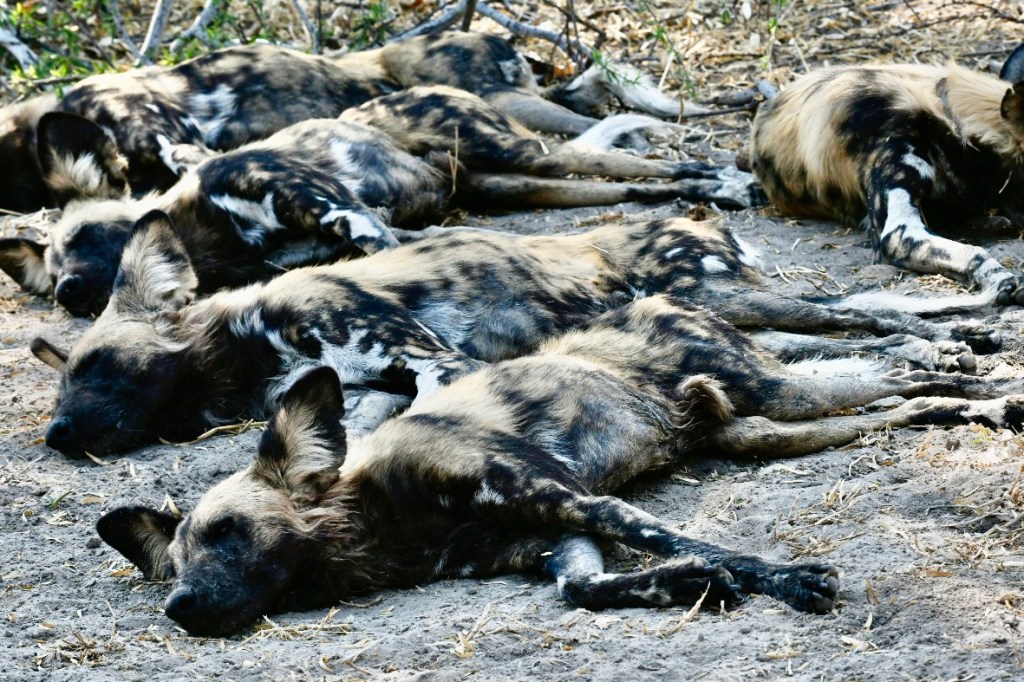
Painted Wolves exhausted after a hunting run. According to our guide they are very hard to see in the wild because they rarely rest.

26 game drives and 15 airplane flights might take the trophy for most repeated activities on the trip if it weren’t for the buffet. Three times a day we line up to select from a collection of dishes that chefs have crafted to feed a crowd. We have lost the pleasure of a leisurely menu scan followed by personal service. The buffet can become a real irritation as you stand behind a person who picks out all the green peppers from the salad and cogitates on the creative merits of the red stew or white stew. If it’s true that a person, “eats with their eyes” it is fair to say that there was a great difference between the look and the taste of most dishes.
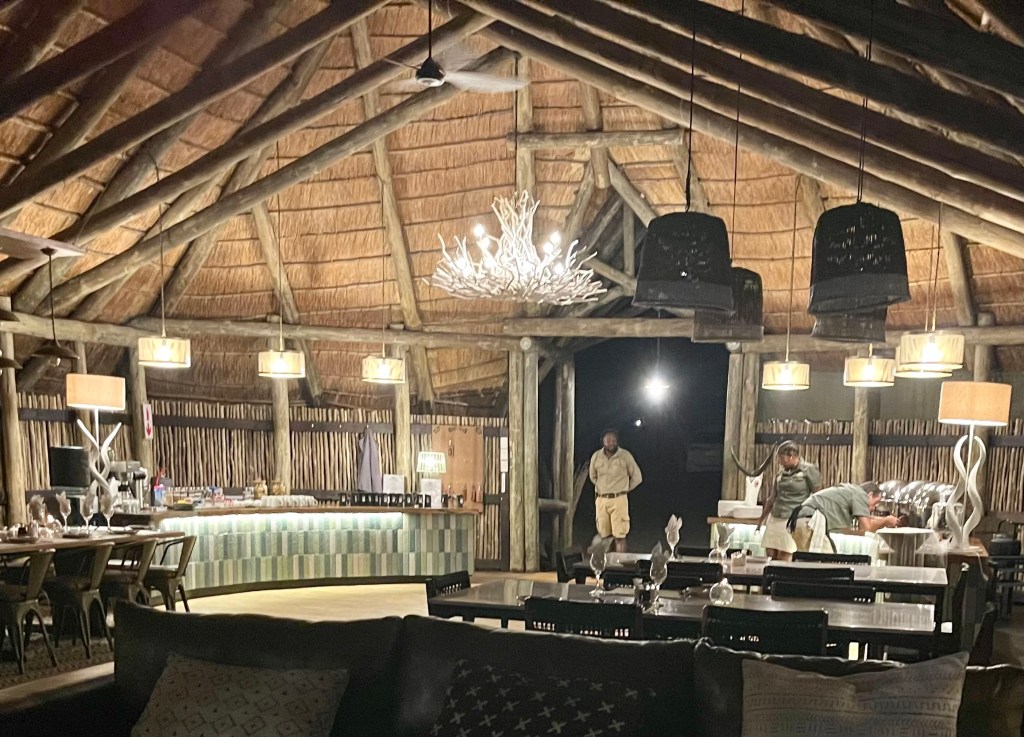
The staff setting up one of our buffets.

My personal dislike of the buffet experience limited me to a diet of oatmeal, eggs, bread and coffee and I had to remind myself that the buffet did not ruin the great experiences of Africa but I missed foods cooked to order and presented at the table. A buffet naturally preceded the big party that was thrown for us when we eventually left Mogothlo. The party was staged on the large deck at the center of the lodge. We participated in African dances and a sing-along. We were asked to present a song for our African hosts and one of our clever companions came up with the idea to sing, “The Twelve Days of Africa.” We Yankees performed with vocal atrocity to the laughter, hoots and disbelief of our African friends.

Dancers at our last night at Mogothlo.

Sunset from our tent deck.

Can you have too many sunset or sunrise photos of Africa? I think not.

A Couple Vagabonds…

African Mysteries

Chobe boasts one of the largest wildlife concentrations in Africa and our game drives bear that out. Giraffe families, hippos’, carmine bee eaters, fish eagles, crocodiles, ibis and herons greet us at every turn.

We will stay at Jackalberry Lodge in the middle of Botswana’s water world. Prior to arrival in Chobe we had become accustomed to a very dry landscape. In Zimbabwe – at the tail end of the dry season – we saw the arid land… the pools and watercourses in Botswana were a welcome change. Botswana also seemed more prosperous than Zimbabwe and Zambia. We learned that Botswana was indeed doing well in economic terms as its per-capita income was growing at a robust 9% rate – a rate that was competitive world wide. Mining, tourism and cattle production led Botswana’s economic boom.

Elephants crossing the Delta

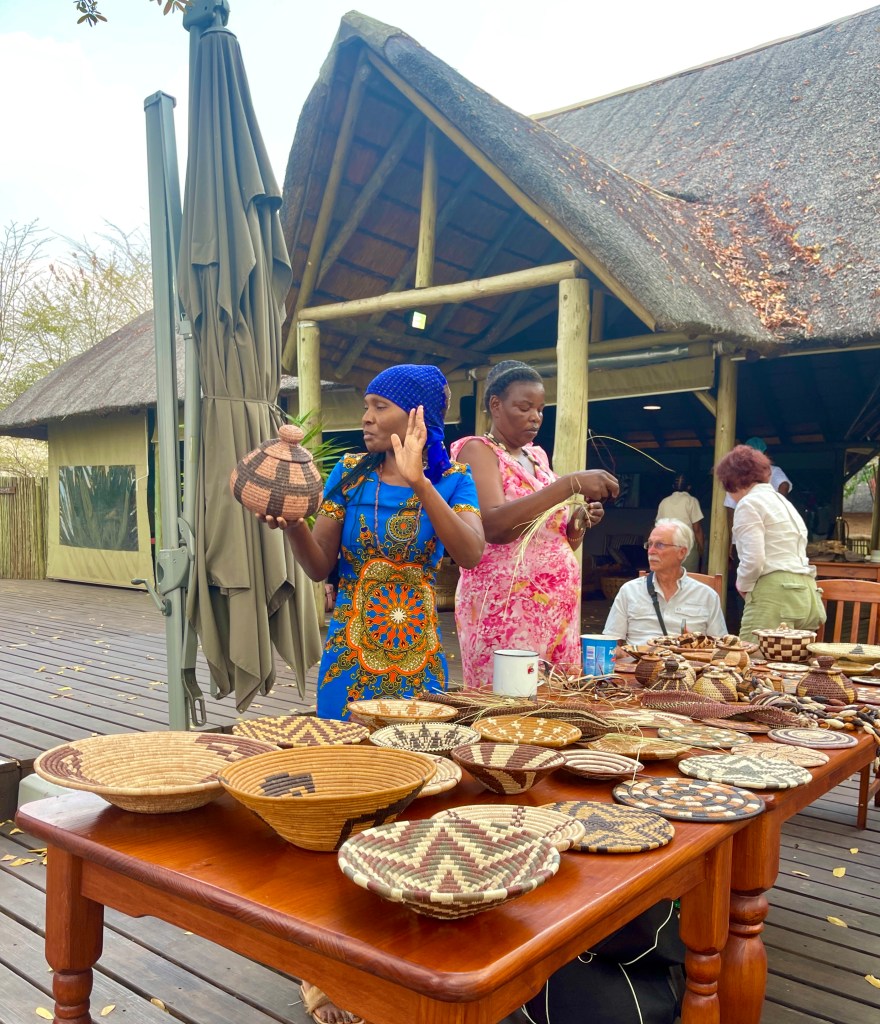
In the afternoon at Jackalberry we were visited by local crafts people who taught us the basics of basket weaving and we all took a shot at the craft…with varying degrees of success. Our instructors work was finely detailed and the baskets came in all sizes and styles. Two of their products now sit on our table at home. We note that we have reached the 14 day mark on the African odyssey.

The local basket weavers.

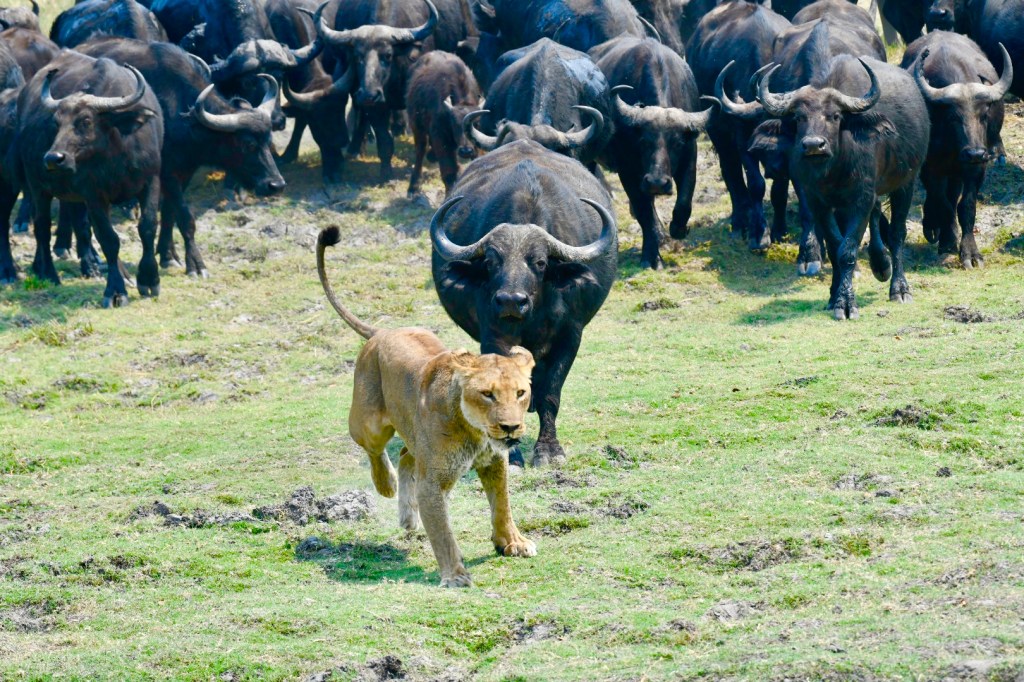
A day of game drives was in the offing and it proved to be a memorable one. We drove up on a scene we had only seen on film. Ten lions were on the hunt. We heard the distinctive warning bark of an impala announcing danger and marked the lions on a stealthy approach to a herd of cape buffalo. The lionesses worked in a crouch through the high grass in a vee formation that cut off retreat on the buffalo herd’s flanks. They slowly closed the arms of the vee to establish a point of attack. All of the predator’s movements were painstakingly slow; their approach took a little more than an hour. We had no sense of time passing as we watched and cameras clicked.

Linda taking as many photos as possible!

The herd responded with multiple position changes to create a defense. A wall of large bodies and deadly horns was a difficult obstacle to the hungry lions but, in time, the lions were able to establish an attack point. A bull buffalo would challenge the lions at their attack point and the lions would repeatedly retreat, regroup and try new launching areas.

Things eventually came to a crisis and the lions charged forward. Two lions actually got on the back of a buffalo, then one slipped under it, then both were driven off by a wall of aggressive defenders. It was a near kill. Group defense drove the lions away until a herd of elephant interposed themselves between predator and prey. We watched this for several hours and realized that we had witnessed “the law of the jungle” in real time and with proximity. We were reminded that something had to die for something else to live.

It was amazing.

Chobe was a definite eye opener.

Our final night at Chobe had arrived and we were regaled by dances and songs performed by the locals. The dances were explosive and complex giving us another taste of tribal culture; and a smooth transition to the travel that would come in the early morning.

A Couple Vagabonds…

African Mysteries

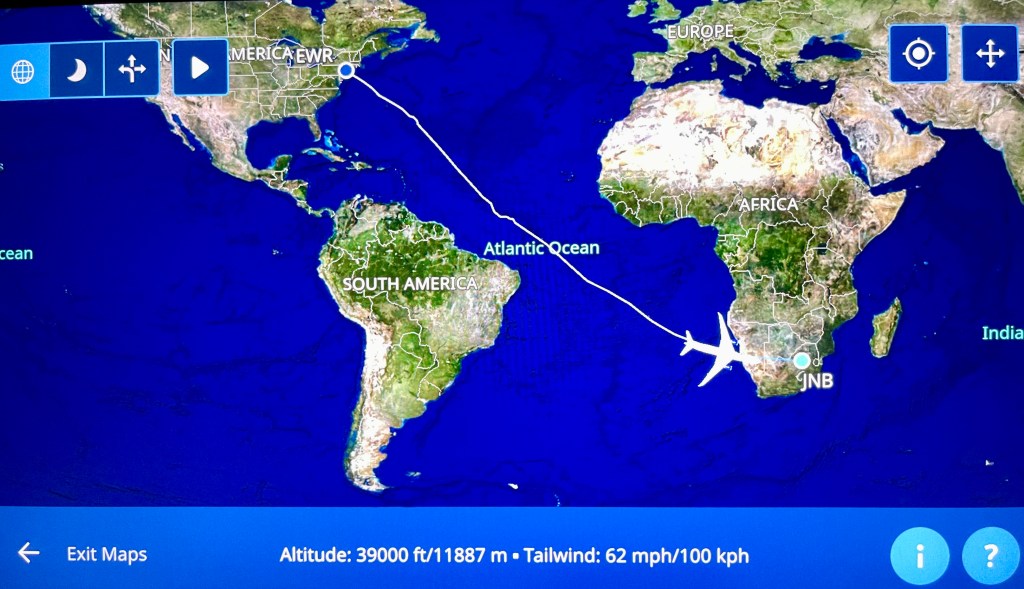
Eventually, our departure day dawned. We faced a nearly six-hour flight to Newark where we would connect with a 16 hour flight to Johannesburg. There was a four-hour layover between our flights which made our travel time a robust twenty-six hours. This had the quality of a pilgrimage and not a vacation. In New Jersey we connected with two friends from Seattle who we had met on a previous trip to Israel, Jordan and Egypt. Jack and Jean were the most serious world travelers we knew. It was hard to mention a spot on the globe they hadn’t seen in person. It was a comfort to have two friends with us and their experience always added to our confidence. As we settled into our airplane seats, the trip certainly seemed to begin on an auspicious note.

We landed in Johannesburg at OR Tambo airport on the afternoon of September 11, 2022. We were at the ragged edge of exhaustion from our flights but there would be little time to recover. We were scheduled to fly again early the next morning. This flight was to Hoedspruit where we boarded a bus to our first camp located just West of Kruger National Park. The Shiduli Lodge offered amenities that proved to be standard in our subsequent camps: tented sites sporting mosquito netting with cans of insecticides and emergency airhorns bedside. Bathrooms were indoors and included a shower…pretty posh. The tents were aligned on either side of a main structure that served as a meeting place, cafeteria and lounge area that featured a well-stocked bar. All of our camps were comfortable and relatively safe. Safety was relative because each camp had different challenges with local wildlife.

After a brief orientation that included the admonition to never walk alone – or after dark – anywhere on the site, we were served tea and led to safari vehicles for our first game drive.

We ventured out into the Karongwe Game Reserve with Charlie at the wheel and Peter in the spotter’s chair at the front of a beefy safari vehicle. We bounced through a herd of impala to the magical dance of African wildlife. The first day views of impala, elephants, baboons and other creatures were astounding for their novelty and unpredictability. We were not in Kansas anymore. Both Peter and Charlie were a tourist’s delight; they enhanced the experience with wit and obvious expertise. Their pride in Africa was infectious and motivating…we were energized and ready to enjoy the safari experience. Both men knew their jobs down to the Latin names of insects, birds and flora. We learned something about everything that scurries around. They spoke English flawlessly much to our relief. They set a great tone on ride number one…a tone that proved to carry us throughout the entire trip.

Back at the lodge, we had a chance to connect with our fellow travelers for the first time since our frantic arrival. We met a financial consultant, ex-teachers, two retired doctors, small business owners and a veteran of the publishing industry. The group was as diverse and interesting as the critters in the bush. This group looked good and promised fun and engagement.

We finally called it a day and retired to room 3. We were serenaded – without pause – by a chorus of frogs that provided the soundtrack for our entire stay. Their zesty croaking was so continuous that one wit quipped that the frog song was actually a continuous loop on a tape machine that was hidden somewhere on the grounds.

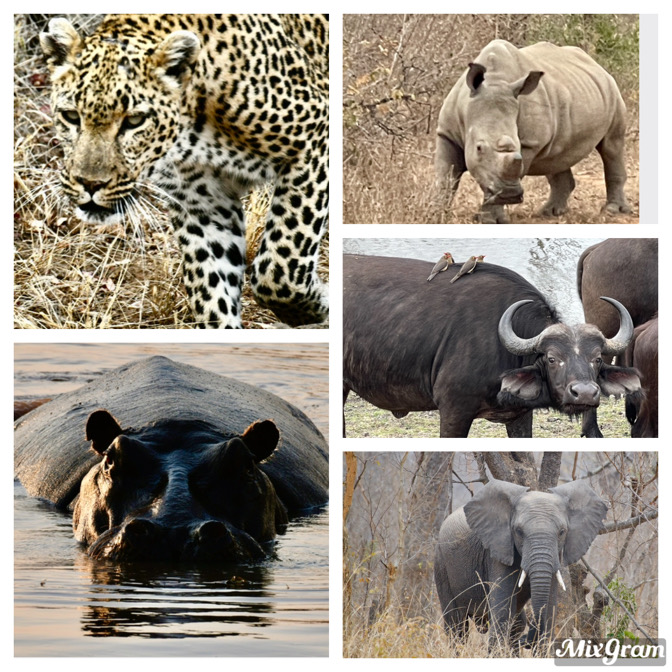
By day three at Karongwe we had seen the Big 5, including the rhinos that had been dehorned for their safety. A “game preserve” is by definition, stocked with wildlife as lodge owners are incentivized to have every guest get the Big 5 experience. For some, these sightings are the measure of a successful trip and we didn’t care that the animals we sighted might have been placed to insure our satisfaction. We were satisfied, indeed.

A memorable dinner of “potjekos” (a traditional African stew) was served under the stars. Potjekos was a combination of carrots, potatoes, cauliflower and meat steamed in a broth on an open fire and the featured meat in our stew was warthog. Unlike a common stew, potjekos is never stirred; it is allowed to rest on the coals until it is ready to eat. Warthog does not “taste like chicken” in spite of the fact that the old line was used everytime we ate something new.

We were introduced to an event that became a standard practice on our evening drives in the bush. The “sundowner” was done on the second game drive of the day as near to dusk as possible. The safari vehicle was parked in a spot that Peter and Charley had scouted for safety. The sundowner began with the unstrapping of a large cooler stuffed with beers, wine, waters and soda. Biscuits and muffins followed and we socialized for twenty minutes – or so – as the fabulous African sunset served as a backdrop. We looked forward to the sundowner, it was the perfect end to every day in the bush. Our four days at the Shiduli Lodge in Hwange had a rhythm of their own as each day featured two game drives, a daily rest in the hot hours of the afternoon, topped with a sundowner after the day’s second game drive.

On one of our drives, Linda got her first “elephant kiss.” We had pulled to the side of the road when a large bull elephant decided to have a closer look at us. The massive animal was suddenly inches from Linda’s face. Peter was quick with advice, telling Linda to freeze and not to scream. Somehow Linda was able to remain silent and immobile while she was checked out. This was the first of many close encounters.

We left Shiduli and flew back to Johannesburg to pick up a new set of travelers that would join us on the next leg of our tour in Zimbabwe, Zambia and Botswana.