A Couple Vagabonds…

African Mysteries

On our last day, many of us wanted to see the sites that figured prominently in the Apartheid battles and Khotsu proves to be a great facilitator. Khotsu will tell us about the biographies of OR Tambo, Nelson Mandela, Desmond Tutu, Steve Biko and add his personal experiences as well. We started the day with a visit to The District 6 Museum followed by a stop at Saint George Cathedral where Tutu served as the Anglican Archbishop of Cape Town.

The District 6 Museum

Mandela was, perhaps the greatest human rights activist Africa ever produced as he finally achieved a level of equality in a country divided by race. Arrested in 1962 by the National Government, Mandela was sentenced to five years in prison but he remained undaunted in his battle for equality and was eventually sentenced to life in prison. In prison, he continued his work for his cause with titanic determination. In 1990 he was released from prison and was elected President of the National Security Council. His story is known world wide and with Tutu as head of the Truth and Reconciliation Commission that investigated human rights violations in the nation the two achieved a non-violent revolution that gave hope to a disenfranchised people. These men were giants in African history and tributes to them dot the Cape Town landscape. From gay rights to black empowerment their achievements are massive. At Saint George Cathedral we paid our respect at the spot where Tutu’s ashes are placed.

An interesting fact emerged when we were told that the two men were the products of the townships…in fact, they grew up on the same street. Valakazi Street actually produced two Nobel Prize winners. At the District 6 Museum, more civil rights history was on display. The National Government actually removed 60,000 people of color from Cape Town’s District 6 and relocated them to the townships. This occurred in the 1970’s and to this day the cleared area remains largely undeveloped. The punitive action had consequences beyond the exclusionism and racism inherent in the deed. The township blight worsened and political tensions rose. Today a group of writers, artists, activists and citizens have created the District 6 Museum to make sure the injustice is not forgotten.

This day is yet another reminder of the incredible contrasts one sees everywhere in Africa. Beauty is everywhere in Southern Africa. In Cape Town, the gorgeous landscape, the bustling port and the majesty of Table Mountain are offset by the ugliness of the townships and the evil of the District 6 action. Like most places in the world, victories are rare and cherished when they occur. Apartheid is defeated but many struggles remain. It can appear that the place is either all progressive or all repressive, rather, it is a study in contrasts, rife with nuance.

We spend our last night in the cape with mixed emotions. We miss home and we will miss Africa. We have experienced fear, awe, disgust, poverty, pain and joy in the compressed time frame of a single month. We all know that processing our African experience will take time but we are all grateful for the chance to see and feel so much.

Our group will dissolve in the morning. Some will fly to their homes directly from Cape Town while others will fly to Johannesburg, to connect with their homebound flights. Some will fly direct to the US and others will make connections in Zurich, Frankfurt and Qatar. We will fly to Johannesburg and catch a flight to Newark. After a four hour layover we will fly to San Diego. In all, our transit will take 27 hours. We are again reminded that we are flying half way around the world. On the plane from Africa, a quote from the Irish novelist George Moore comes to mind: “a man and a woman travel the world over in search of what they need and return home to find it.” Finding Africa will ultimately happen at home. It will take some time.

The trip can be quantified as follow: 15 airplane flights, 27 game drives, 4 Unique African Nations, 3,897 photographs, 25 packings and re-packings, 35,000 air miles, 12 medicines, 32 days of malaria pills and 5 (As in Big)

The numbers are insignificant compared to the quality of the African adventure. In the days since we arrived home we find ourselves reading about Africa and listening to its music. The on-going interest is the gift we were given on this amazing journey. While the trip was gritty and uncomfortable at times…it was also compelling, beautiful and amazing.

As Marcel Proust once wrote, “the real voyage of discovery consists not in seeking new landscapes but in having new eyes.” Africa offered a spectacular vision and we now had new eyes with which to see it.
A Couple Vagabonds

African Mysteries

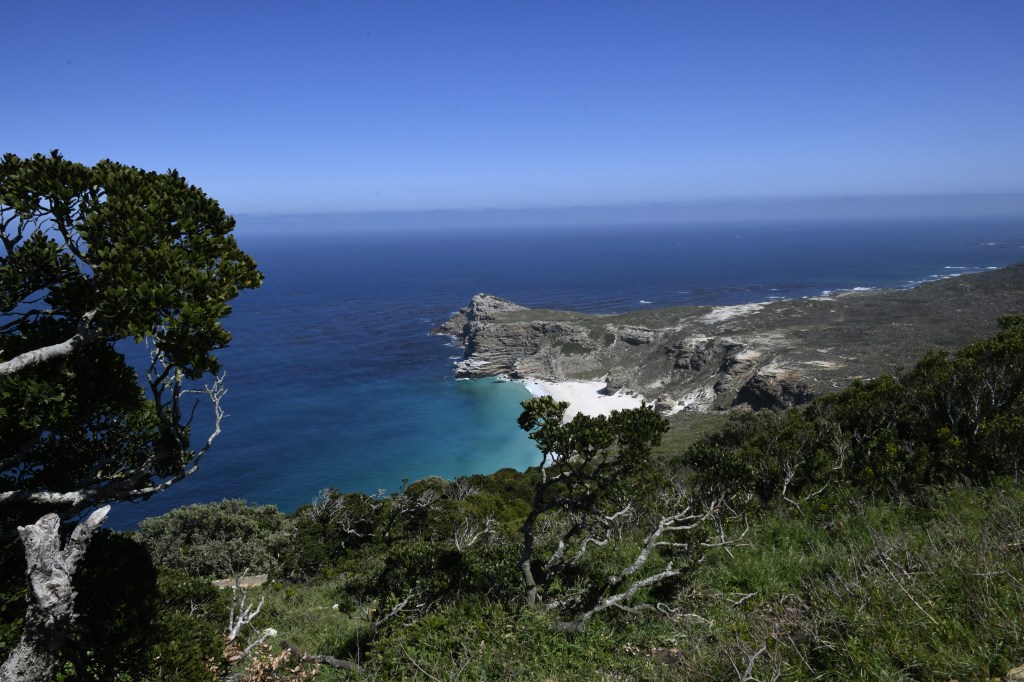
The next day’s trek will take us down the Atlantic coast to the Cape of Good Hope. On our way to the southwestern-most point on the African continent, we note surfers, rocks that some mistake for whales, roadside ostriches and long lines of container ships slowly steaming to the port. The beaches are beautiful with people about the business of recreation. The original name for the cape was coined by Bartholomew Diaz in 1487… The Cape of Storms (Cabo Das Tormentas). Eventually, this name proved to be bad for business and it was changed to the cheery title it has today. Legends in and around the Cape are many and long lived, including the famous tale of the Flying Dutchman and its crew of ghostly sailors. We are all aware of the fact that we have arrived at one of the most famous places on earth. We appropriately take hundreds of pictures at the post that is so prominent in lore.

On the return trip up the coast, Khotsu recommends a stop at Simonstown, one of the most picturesque towns on the route. We stop for fish and chips at The Salty Sea Dog and the hake and chips are characteristically excellent.

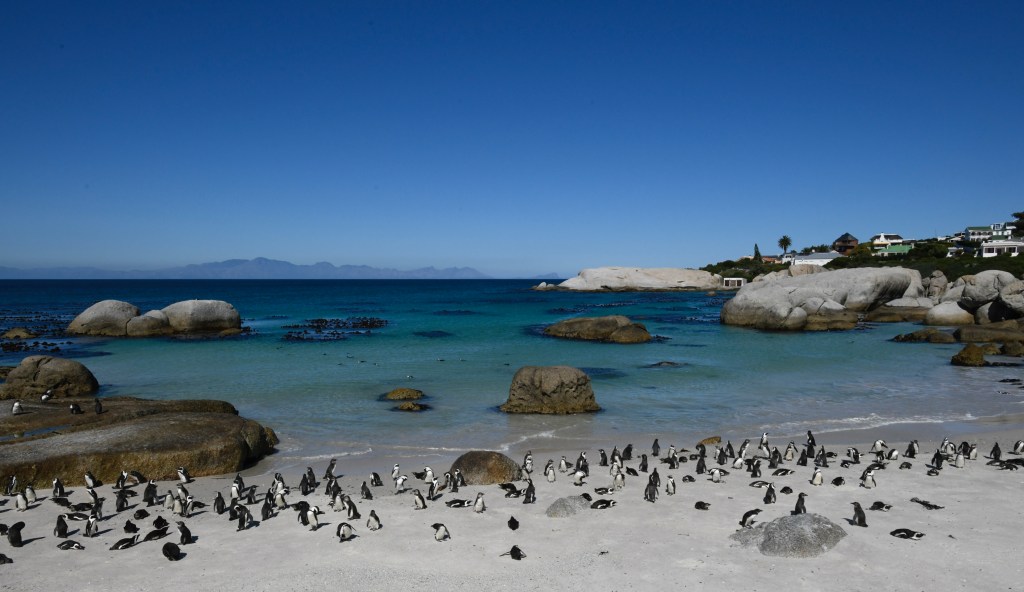
After lunch, we move up the coast to Boulders Beach to observe a penguin colony…a group that old hands at the cape have named, “jackass penguins”. Like the cape itself, this title went through a sanitation and the jackasses are now referred to as Cape Penguins in all the tourist publications. The unlikely birds are amusing and fascinating by any name.

We are watching more than 1,000 breeding pairs in full waddle from a boardwalk that leads directly to the beach.

These birds are only found on this coast and they torpedo through the cove and entertain us with constant braying. This beach is a “must-see” for all tourists and some actually rent vrbos to facilitate long sessions of contact…the birds are a destination.

We head back to our hotel and en route, Khotsu briefs us on tomorrow’s itinerary which includes a long day in Stellenbosch in the heart of South Africa’s wine country.

Prior to departure for the wine country visit an interesting scene develops at our breakfast buffet. A large group of local teenagers has taken over the Hotel. They are the best students in math and science from regional schools and a stay at the hotel is their reward for their academic achievements. The kids were amazed by the hotel elevators and they crowded in and rode them up and down repeatedly. They were equally stunned by the buffet where limitless food was on offer. Kids were piling eggs, bacon, fruit and cheeses on their plates and most had erected towers of bread slices on a side plate. The largest tower reached an impressive seven slices and few boasted nothing less than four slices. After eating all of this food many were filling their pockets with any food that was portable. This was a cornucopia for children who had limited food resources in their homes.

The poverty of these kids was as clear as their intelligence. As we watched the food cacheing it was clear that these kids were used to severe poverty and as they paraded around us – people who were never hungry – it seemed like a microcosm of Africa. So many vivid contrast and harsh juxtapositions had been presented on the trip and this was yet another. We had seen life/death, wet/dry, beauty/ugliness, poverty/excess and a host of other relationships, but the experience of the privileged tourists that never had to stockpile food dining with those who were always hungry was sobering, indeed. It was a good time for us to be grateful for all of our advantages.

On our drive to the wine country, the manifestations of poverty continued to bombard us as we pass through the townships that dot the outskirts of Cape Town.

Townships are the embodiment of the horrors of exclusion and racism that has dogged Africa for generations. There are over 500 townships in the area where poor Africans, Asians, Arabs and people of color eke out their lives. The history of the townships begins with the effort to concentrate cheap labor (black labor) in areas close by industrial undertakings including coal, mineral and diamond mines. Centralizing a captive labor force proved a boon to the bottom line. Add racism to this mix and the “dormitory towns” become a sink of poverty and desperation. The living conditions are bleak and no social services or infrastructure are available. The poverty is staggering. In modern times, many people of color were relocated to these areas. We will learn more about this later.

The contrast between the townships and Stellenbosch couldn’t have been more dramatic.

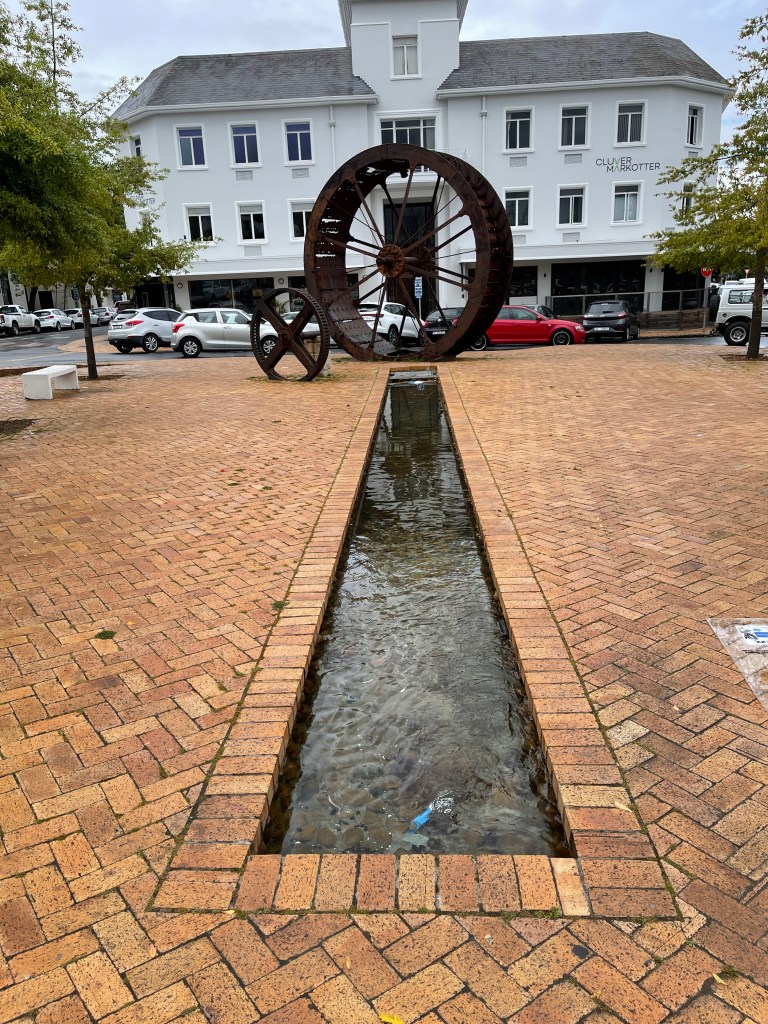
Our first stop in Stellenbosch included a tour of the Dutch mansions built from the 1600’s to the nineteenth century. Each home had its “servants quarters” and after the townships we knew what that meant. The town includes a university and a vibrant commercial district. The town was founded in 1679 by Simon van Der Stel, the governor of the Cape Colony. In a self-effacing manner, Simon named the town after himself. Dutch influence is everywhere from the impressive water works to the names on the shops. Today more than 70,000 people live in the town.

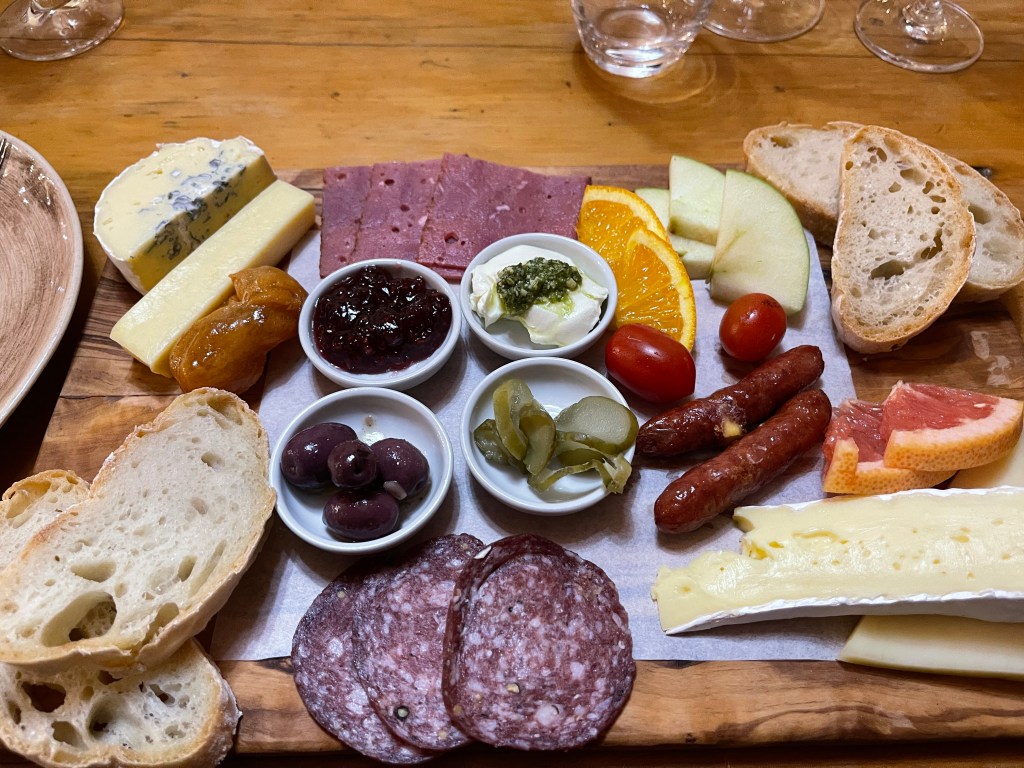
In short order we arrive at the first of three wineries that we will visit. We are led to the tasting room at Murati Wineries and we are presented with individual charcuterie boards heavy with items for pairing with the wines.

We also get a short course on South African wine. While some believe that the region’s first grapes were planted by Huguenot refugees fresh from persecution in France, the father of the industry is Jan van Riebeck, the Governor of Cape Town who produced wine for public consumption in 1659. Soils in the region carry high concentration of clay, sandstone and shale that give depth to the flavor of the wines. In fact, more than 50 soil types are found in the Stellenbosch region making flavor varieties a certainty. We will sample them at the Murati, L’avenir and Dornier estates before the day is over.

The real stars of the wineries are the estates themselves. Groomed grounds, water features and formal gardens made the surroundings as pleasant as the vintages. During our rest in these Edenic surroundings we become aware of the fact that tomorrow will be our last day in Cape Town and the last non-travel day of the trip. Our African adventure is coming to a close.

A Couple Vagabonds…

African Mysteries

Capetown is known as “the mother city” of southern Africa, a city that sits at the base of Table Mountain in southwestern Africa. In historic terms, the first mention of the area by a European was by Bartholomew Diaz in 1488 during an attempt to round the cape. Vasco de Gamma actually mentions the cape in his ships’ log in 1487, slightly stealing Bartholomew’s thunder. After the cape contacts achieved by the Portuguese navigators, the sailors of the Dutch East India Company established a supply station and they visited regularly between 1652 and 1797. Their influence on the city remains in the architecture, signage and language of Capetown. Before long, the British arrived and defeated the Dutch at the battle of Blaauwberg in 1806. The British influence remains strong. Colonial events established Capetown as the “first city” – the mother city – of Southern Africa.

Our first activity in Capetown is a home-hosted dinner where we would meet locals and hear their stories. We were less than fresh and our conversation quickly devolved into a long discussion of cuisine, cooking techniques and the building of the dishes that were served. The two ladies who hosted us were lively and charming and we enjoyed the talk of domestic issues rather than current events or future visions. The talk was relaxing and just light enough after our flight.

We returned to The Sunsquare City Bowl Hotel and the following morning a buffet breakfast waited us – as usual. We happily anticipated the walkabout in the city that would start after breakfast. Our new guide was Khotsu an energetic man who immediately informed us that his name meant “peace.” He headed us into the city, through multi-colored Dutch neighborhoods and informed us of the fact that our day would consist of a visit to the top of Table Mountain followed by a leisurely stroll through the gardens of Kirstenbosch.

We took the famous funicular ride to the summit of the mountain and were in agreement that the mountain’s status as a “new 7th wonder of nature” site was well deserved. At 3,564 feet of elevation we found rich biodiversity and breathtaking views of the surrounding country. Over 8,000 plant species have been identified on the mountain (to date) and the place is home to hyrax, peregrine falcons, baboons and many other animals. The mountain top was a feast for the eyes.

The native name for the mountain is hoerikwagoo which translates to, “the mountain of the sea”, a name which is apt because one can view the entire coastline that leads to the Cape of Good Hope and the Atlantic port of Cape Town, in a single view. Table Mountain was one of the rare places you don’t want to leave but we were boarding a van for a ride to the gardens at Kirstenbosch.

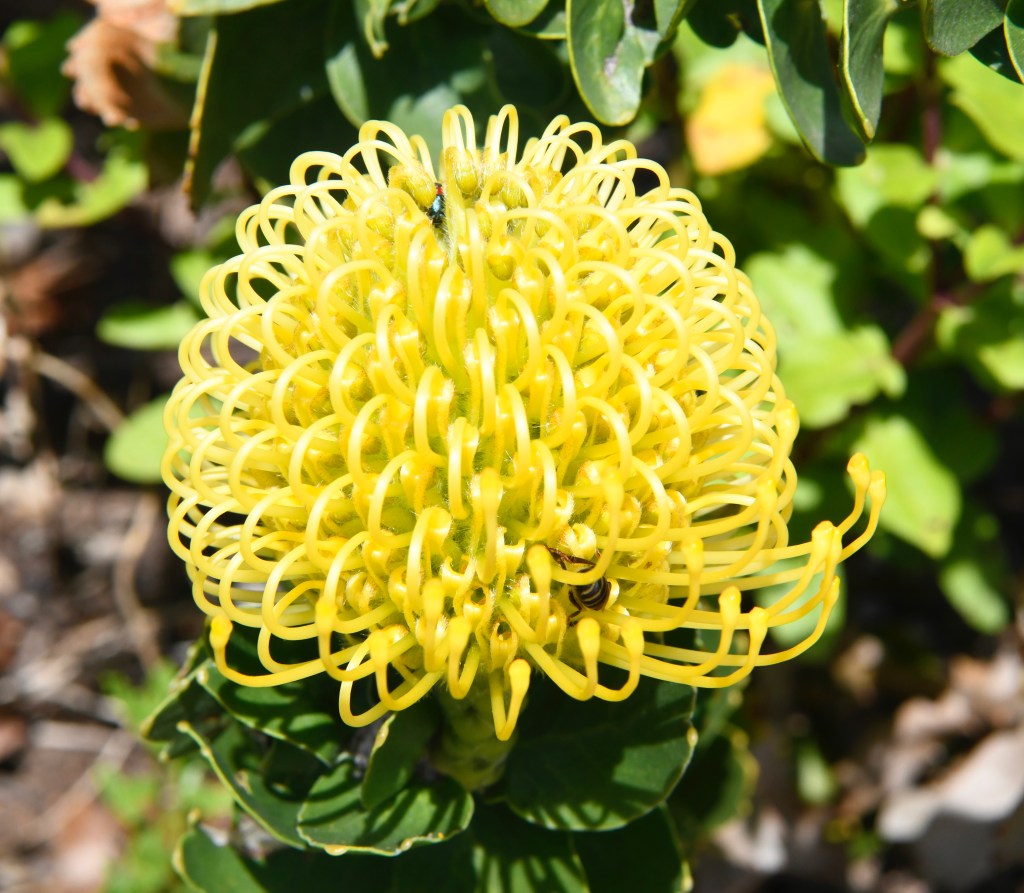
The quiet, contemplative walk in the lush gardens among 41,000 species of indigenous flowers and other flora gave us the opportunity to decompress as we strolled among the monumental statuary and a stand of King Proteus, the national flower of South Africa. After a visit to the nesting owls in the garden, Khotsu suggested that we travel to the Capetown waterfront for lunch.

The Capetown Waterfront is a gem in the ring of the city where shopping malls, arcades, restaurants, a performance space and a clutch of shops are set along the harbor front. Some of the best seafood in the world is served in the harbor and we experienced that quality. After lunch, Khotsu suggested that we walk a few miles back to our hotel, a march that furthers our boots on the ground contact with the city. Back at the hotel, free time is declared and we are pleased with the opportunity to refresh, re-pack and regroup. Leisure time is at a premium.

A Couple Vagabonds…

African Mysteries

Johannesburg is a young city that was incorporated in 1886. Prior to that incorporation, tribes, the English, Dutch, Germans and Portuguese had all put down roots. You can hear five official languages in the “City of Gold” – a truly diverse place. The city boasts the world’s largest hospital, the tallest building on the African continent and one of the continent’s most vibrant economies. For us, it will be a hub for arrivals and departures. Our stay will be a characteristically short one; a quick overnight to fill out our travel group. Happily, our hotel contains a first-floor pub called Rosie O’Grady’s and we quickly rush there for food and an attitude adjustment. If there is anything I understand in this world it is an Irish Pub. Spirits are lifted both figuratively and literally.

Our comfort was short lived as the trip’s first crisis appears. One of our Hwange companions suffers from severe hydration and kidney distress. He has collapsed more that once and shows the classic symptoms of system failure: dizziness, loss of balance and severe cognitive impairment. Our retired doctors rallied around immediately to get him hospitalized. Eventually, there was enough recovery for the man to fly home with an escort. As our trip continues we will do regular checks on the man’s recovery. His travel partner is in constant touch with the man and his family and shares progress reports with the group. Those of us that remain in Africa get the point that there will be no lack of drama on this journey. We press on.

Our flight from Johannesburg to Victoria Falls Airport is followed by a long bus ride to Hwange in Zimbabwe. The dryness of the Kahlahari Desert is palpable. Hwange National Park was established in 1928 and it currently hosts over 100 animal and 400 bird species. It is a target rich environment for our photographers. On our way to camp we encounter our first kori bustard, a classic sign of good luck in tribal culture. The largest bird in Africa that is capable of flight, the kori bustard becomes a kind of propitious talisman for the group and their booming calls resonate with us. We look for them on our afternoon drive through the stands of teak, acacia trees and scrub growth.

When we arrive at the lodge, we gather for an orientation where we are told that we must never walk alone anywhere in the compound after day without an armed guard. An armed escort – with a high powered hunting rifle will lead us to our tents. Linda and I are happily ensconced in tent number 9, the tent that is furthest from the security of the lodge. The drama is further enhanced by the guide who remarks that a leopard has found a home in a tree 20 feet from our tent. We crawl under the mosquito netting with a bit more than mild anxiety.

In the morning, we will have visitors that will take advantage of tent 9’s location at the far end of the compound. Tent 9 had the best, unobstructed view of the beautiful African sunrise and Linda has invited her fellow photogs to a five am shoot on the tent’s east facing deck. It is dark when the gathering begins so the visitors are escorted by the armed guard who sidles up to Linda and asks, “don’t you have sunrises in America?” Linda simply replies, “not African ones.”

Our two-a-day game drive schedule continues in Hwange. Kashawi Camp gives us our first chance to get to know Sku, our trip leader. Sku is the diminutive for Sikhumbuzo Mayo. We all agree that “Sku” was the better name as our mouths can’t quite get around his full name – a real tongue twister for us Yankees. Over the next few days Sku becomes indispensable and one of the best parts of the trip. His contributions to our education and enjoyment were constant and he delivered cultural knowledge and animal identification with impressive patience and wit. Sku was a family man with Zulu roots who was proud of his wife Samurai and his children. He was also proud of Africa in a way that was engaging and instructive. The cultural inputs that Sku provided included a visit to a local school and a local village. He coordinated dinner visits with local families and conducted talks about various subjects including mining, trophy hunting and the political history of Zimbabwe. His most important efforts were those that got us closer to the African people. Sku also created cohesion in our group by encouraging us to ride with different people in different vehicles to give our photographers the best and varied views. Sku was a gem.

Sku also acted as a source for continuing education as he suggested books, music and art that we could access long after the trip was over. He shared his personal story and the fact that his Zulu heritage was somewhat problematic. The Zulus were the premier warrior culture in southern Africa and their historic campaigns and depredations negatively impacted most people in the region and the resentment and lack of trust has survived to the present day. Sku made the words of Edith Wharton come to life. Wharton wrote, “one of the great things about traveling in Africa is that you find out how many good, kind people there are.” Sku proved Wharton’s case.

After the meeting with Sku, we were scheduled to visit the students at St. Mary’s Primary School, and the local village of Lukhosi…the central village of the Nambya people. After a short ride to the school, we were assigned a student for a one-on-one discussion about the student’s background, goals and dreams. My student – Nyssa – shared her dream of becoming a biologist. Math and science were her favorite subjects and her favorite activity was tennis. She was the epitome of the charming teenager, and it was inspiring to see her rise above so many obstacles to pursue her dreams. We shared some gifts, including school supplies, soccer balls, clothing and cash that was donated earlier through our tour structure.

Nyssa’s school was founded by the Catholic Church and the Catholic Church influence was manifest in much of Zimbabwe. Whether the motivation was evangelism, colonialism or something else tended not to matter as we saw the heavy investment that was made in the welfare of the people. We departed the school knowing that we had been charmed.

We were soon off to the Lukhosi village. On the way, we stopped at what Sku called, “the African shopping mall” where we purchased gifts for the village to comply with the African tradition of bringing gifts to our hosts. The “shopping mall” was a series of low-slung cinder block buildings complete with goats and dogs that ran about the place. Our gifts were very practical including large bags of rice, millet, corn meal and sugar. We sweetened the trove with bottles of cooking oil. These items would satisfy the tradition and make a real contribution to village welfare.

We were in for a few surprises.

Lukhosi Village

We were tasked with making mud bricks with soil gathered from termite mounds and pounded grains in large mortars.

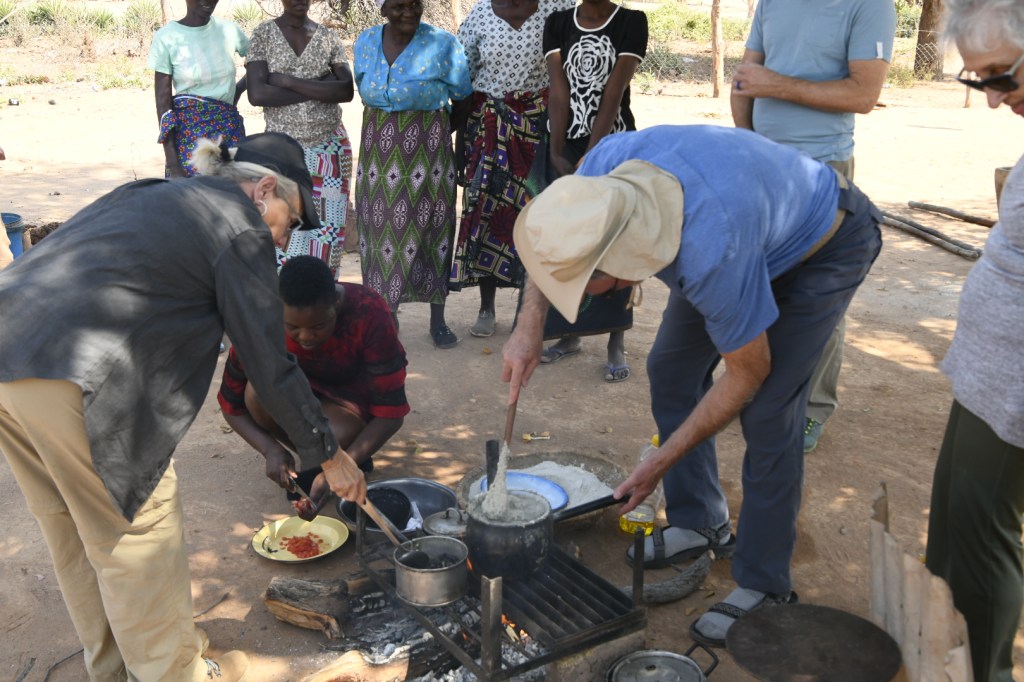
Finally, after a bit of work, we were rewarded with a feast. The village women presented us with a delicacy – a heaping plate of mopane worms. The worms are actually a species of emperor moth and they are an edible caterpillar. The “worms” are eaten by native people throughout Southern Africa and they provide protein to the local diet. The first step in their preparation is a sustain boil followed by a light sauté. Tomatoes, onions and salt are added. The taste is often described as similar to well done beef or beef jerky. They did not taste like chicken. The worms were not eaten by all the travelers but I added them to my travel menu that includes, piranha, goat, warthog, alpaca, guinea pig and other regional foods. Strangely they were very good.

Our fellow travelers helping to make the Mopane worms.

A Couple Vagabonds…

African Mysteries

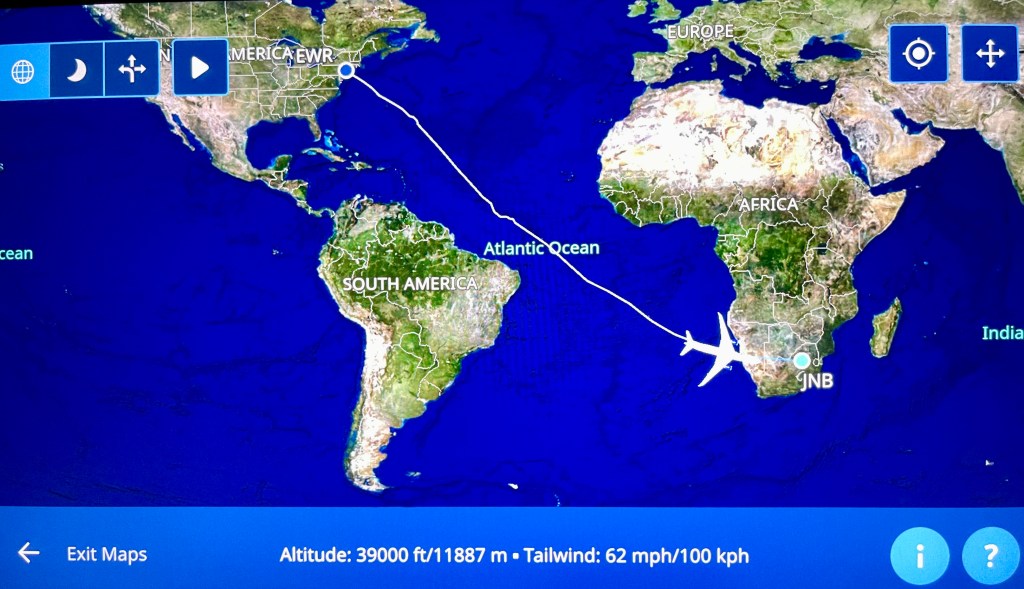
Eventually, our departure day dawned. We faced a nearly six-hour flight to Newark where we would connect with a 16 hour flight to Johannesburg. There was a four-hour layover between our flights which made our travel time a robust twenty-six hours. This had the quality of a pilgrimage and not a vacation. In New Jersey we connected with two friends from Seattle who we had met on a previous trip to Israel, Jordan and Egypt. Jack and Jean were the most serious world travelers we knew. It was hard to mention a spot on the globe they hadn’t seen in person. It was a comfort to have two friends with us and their experience always added to our confidence. As we settled into our airplane seats, the trip certainly seemed to begin on an auspicious note.

We landed in Johannesburg at OR Tambo airport on the afternoon of September 11, 2022. We were at the ragged edge of exhaustion from our flights but there would be little time to recover. We were scheduled to fly again early the next morning. This flight was to Hoedspruit where we boarded a bus to our first camp located just West of Kruger National Park. The Shiduli Lodge offered amenities that proved to be standard in our subsequent camps: tented sites sporting mosquito netting with cans of insecticides and emergency airhorns bedside. Bathrooms were indoors and included a shower…pretty posh. The tents were aligned on either side of a main structure that served as a meeting place, cafeteria and lounge area that featured a well-stocked bar. All of our camps were comfortable and relatively safe. Safety was relative because each camp had different challenges with local wildlife.

After a brief orientation that included the admonition to never walk alone – or after dark – anywhere on the site, we were served tea and led to safari vehicles for our first game drive.

We ventured out into the Karongwe Game Reserve with Charlie at the wheel and Peter in the spotter’s chair at the front of a beefy safari vehicle. We bounced through a herd of impala to the magical dance of African wildlife. The first day views of impala, elephants, baboons and other creatures were astounding for their novelty and unpredictability. We were not in Kansas anymore. Both Peter and Charlie were a tourist’s delight; they enhanced the experience with wit and obvious expertise. Their pride in Africa was infectious and motivating…we were energized and ready to enjoy the safari experience. Both men knew their jobs down to the Latin names of insects, birds and flora. We learned something about everything that scurries around. They spoke English flawlessly much to our relief. They set a great tone on ride number one…a tone that proved to carry us throughout the entire trip.

Back at the lodge, we had a chance to connect with our fellow travelers for the first time since our frantic arrival. We met a financial consultant, ex-teachers, two retired doctors, small business owners and a veteran of the publishing industry. The group was as diverse and interesting as the critters in the bush. This group looked good and promised fun and engagement.

We finally called it a day and retired to room 3. We were serenaded – without pause – by a chorus of frogs that provided the soundtrack for our entire stay. Their zesty croaking was so continuous that one wit quipped that the frog song was actually a continuous loop on a tape machine that was hidden somewhere on the grounds.

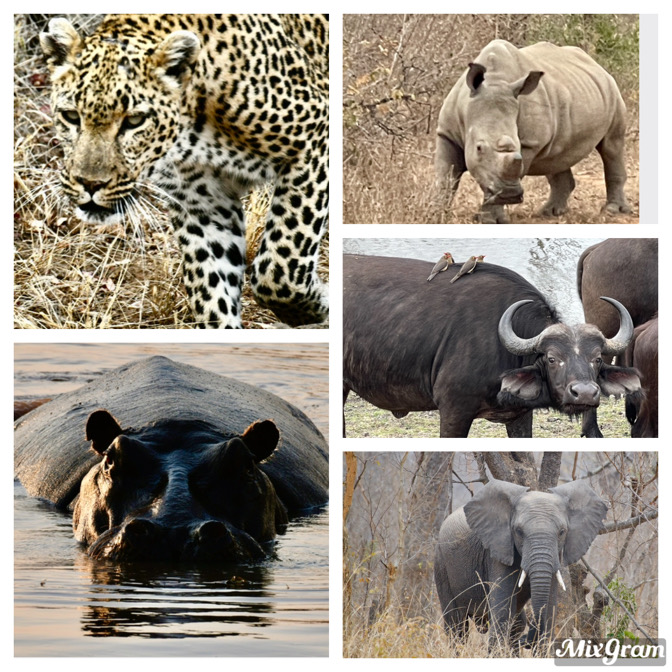
By day three at Karongwe we had seen the Big 5, including the rhinos that had been dehorned for their safety. A “game preserve” is by definition, stocked with wildlife as lodge owners are incentivized to have every guest get the Big 5 experience. For some, these sightings are the measure of a successful trip and we didn’t care that the animals we sighted might have been placed to insure our satisfaction. We were satisfied, indeed.

A memorable dinner of “potjekos” (a traditional African stew) was served under the stars. Potjekos was a combination of carrots, potatoes, cauliflower and meat steamed in a broth on an open fire and the featured meat in our stew was warthog. Unlike a common stew, potjekos is never stirred; it is allowed to rest on the coals until it is ready to eat. Warthog does not “taste like chicken” in spite of the fact that the old line was used everytime we ate something new.

We were introduced to an event that became a standard practice on our evening drives in the bush. The “sundowner” was done on the second game drive of the day as near to dusk as possible. The safari vehicle was parked in a spot that Peter and Charley had scouted for safety. The sundowner began with the unstrapping of a large cooler stuffed with beers, wine, waters and soda. Biscuits and muffins followed and we socialized for twenty minutes – or so – as the fabulous African sunset served as a backdrop. We looked forward to the sundowner, it was the perfect end to every day in the bush. Our four days at the Shiduli Lodge in Hwange had a rhythm of their own as each day featured two game drives, a daily rest in the hot hours of the afternoon, topped with a sundowner after the day’s second game drive.

On one of our drives, Linda got her first “elephant kiss.” We had pulled to the side of the road when a large bull elephant decided to have a closer look at us. The massive animal was suddenly inches from Linda’s face. Peter was quick with advice, telling Linda to freeze and not to scream. Somehow Linda was able to remain silent and immobile while she was checked out. This was the first of many close encounters.

We left Shiduli and flew back to Johannesburg to pick up a new set of travelers that would join us on the next leg of our tour in Zimbabwe, Zambia and Botswana.