The day after our village visit was the first time we experienced the African bush place. We flew to Livingstone in Zambia where we were to take a bus from the dirt airstrip to Kafue National Park. Kafue was created by an initiative to link multiple park areas to form a large, “conservation area” around the Kafue River region. Rivers and swamp areas ring Kafue creating habitat for more than 50 animal species and a home for more than 500 bird communities. We were promised a rich animal experience.
The Kafue River, Zambia
We will stay at the Lufupa Tented Camp on the banks of the Kafue River. Linda and I are booked into tent number one and as we move to the tent we realize that we are again at the farthest distance from the lodge site. That night we hear a continuous scrabbling below the tent and are informed that the sound comes from Lulu the warthog and her five offspring who are nested below us. Lulu and family call Lufupa home and for the next few days we will do the same. Lulu doesn’t seem to mind the intrusion.
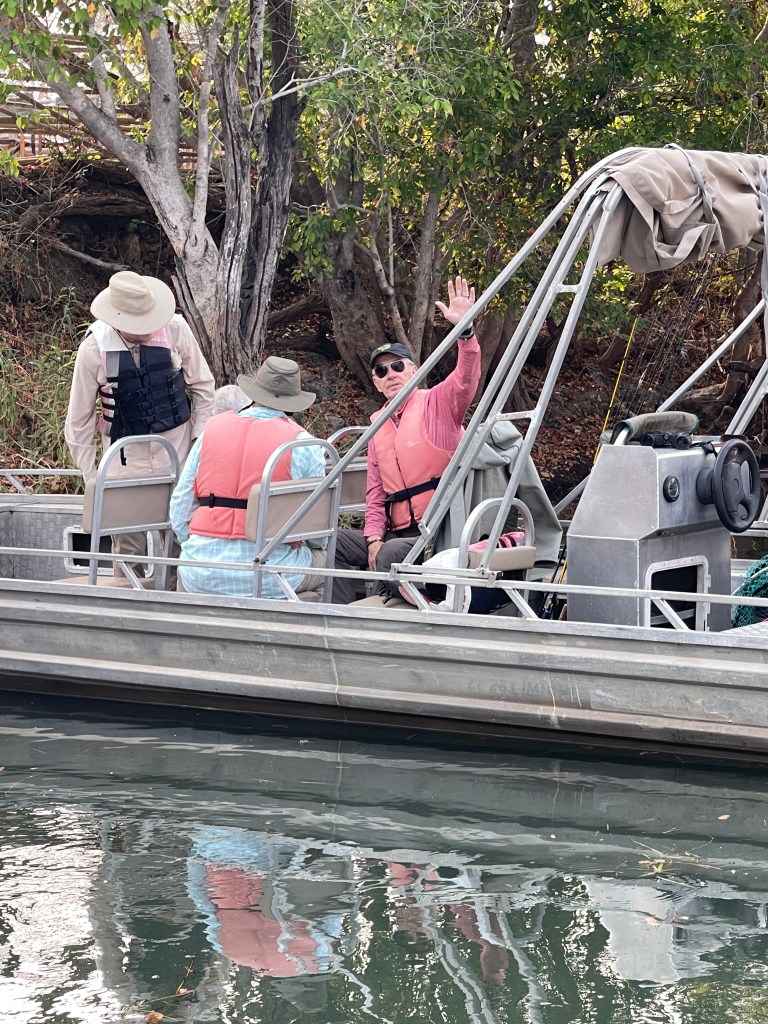
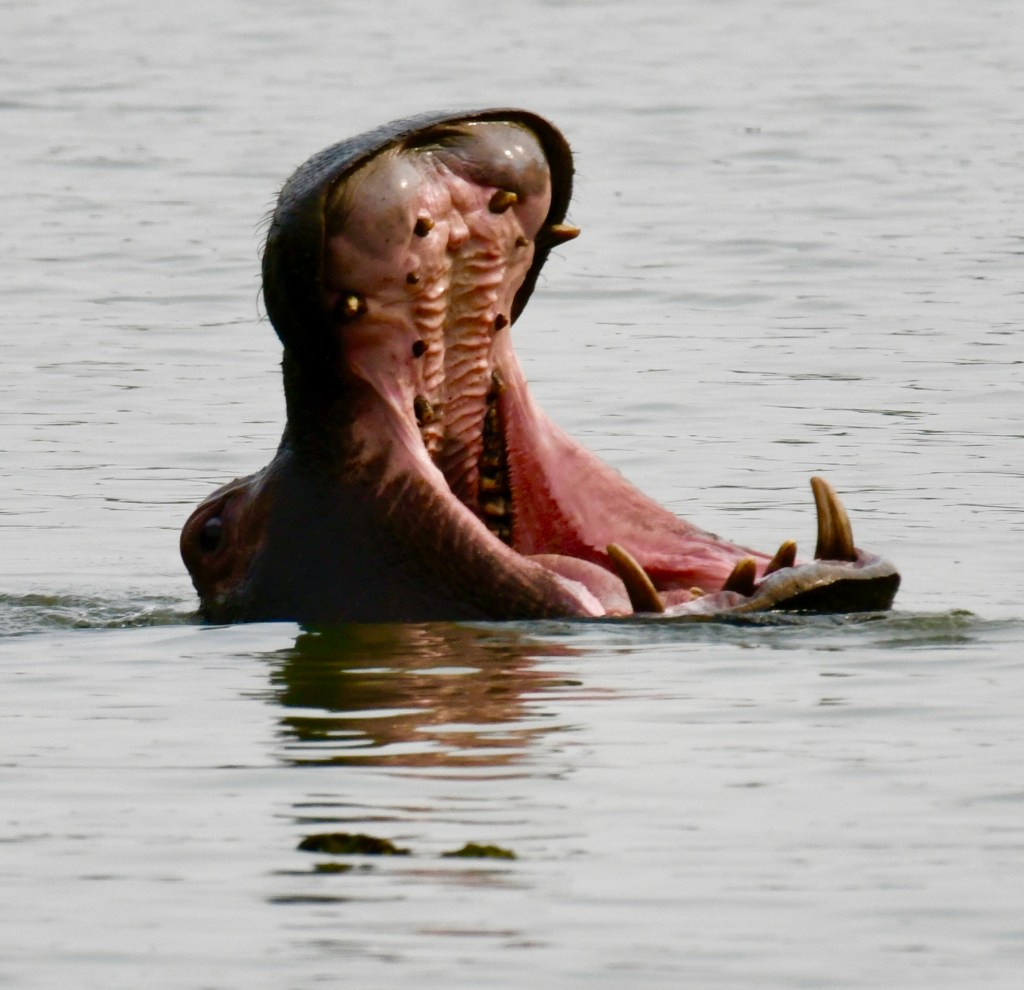
The men in the group spend the afternoon fishing for bream and tilapia while the women float the river on a game viewing cruise. It proved to be nerve wracking to be on a small boat with five large men casting from every point on the compass. Hooks were flying from every direction but we miraculously avoided any punctures. The trip was successful as enough fish were landed to make a serious contribution to the evening’s dinner menu. The ladies were rewarded with close ups of the hippos and crocs.
The men went fishing, while the women
went to see animals along and in the river.
After dinner, the night game drive offered two quick lessons about local matters. The first lesson was about the omnipresent tsetse fly. This aggressive insect had an outsized role in African history because of its transmission of disease and its painful bite. The second lesson was in relation to the tsetse fly and it concerned the many uses of elephant dung. The smell of DEET and other insecticides hung in the air but the greatest relief from the pests came from an old paint can full of burning elephant dung that hung from the rear bumper of the safari vehicle. The tsetse is a member of the family that includes the common housefly, a fact that made its blood sucking bite no less painful. Their relentless attacks led directly to a short course on the uses and benefits of elephant dung.
Our guide shared the knowledge as he picked up balls of semi-dry dung and stuffed them into the paint can fire. The resulting smoke drove the flies away long enough for him to share dung factoids. The same smoke that stopped the insects was also used for pain relief. Dung is also a renewable energy source and a food source for birds and baboons that eat undigested seeds in the scat. Elephants produce enough dung in a day to produce 115 sheets of very fine paper. In addition to being a high-quality fertilizer, the dung is also used in the production of artisanal beers and coffees. Perhaps the most disgusting use was the fact that bush people facing dehydration can squeeze water from the dung to avoid a grisly death. Like almost everything in Africa, elephant dung was a good deal more than what met the eye.
Our last day in Kafue was bittersweet as we looked forward to our next camp and regretted leaving a magical place. In the morning, we will leave Lufupa Camp for a bush plane flight to Chobe National Park in Botswana. We bounced into Botswana on the thermals and crosswinds of the desert and as we bump into a landing on a dirt strip, we taxi past a dilapidated shed that contains old rags and a single first extinguisher. As we pull even with the structure the pilot announces, “Terminal One.” We were happy to be on the ground.
Johannesburg is a young city that was incorporated in 1886. Prior to that incorporation, tribes, the English, Dutch, Germans and Portuguese had all put down roots. You can hear five official languages in the “City of Gold” – a truly diverse place. The city boasts the world’s largest hospital, the tallest building on the African continent and one of the continent’s most vibrant economies. For us, it will be a hub for arrivals and departures. Our stay will be a characteristically short one; a quick overnight to fill out our travel group. Happily, our hotel contains a first-floor pub called Rosie O’Grady’s and we quickly rush there for food and an attitude adjustment. If there is anything I understand in this world it is an Irish Pub. Spirits are lifted both figuratively and literally.
Our comfort was short lived as the trip’s first crisis appears. One of our Hwange companions suffers from severe hydration and kidney distress. He has collapsed more that once and shows the classic symptoms of system failure: dizziness, loss of balance and severe cognitive impairment. Our retired doctors rallied around immediately to get him hospitalized. Eventually, there was enough recovery for the man to fly home with an escort. As our trip continues we will do regular checks on the man’s recovery. His travel partner is in constant touch with the man and his family and shares progress reports with the group. Those of us that remain in Africa get the point that there will be no lack of drama on this journey. We press on.
Our flight from Johannesburg to Victoria Falls Airport is followed by a long bus ride to Hwange in Zimbabwe. The dryness of the Kahlahari Desert is palpable. Hwange National Park was established in 1928 and it currently hosts over 100 animal and 400 bird species. It is a target rich environment for our photographers. On our way to camp we encounter our first kori bustard, a classic sign of good luck in tribal culture. The largest bird in Africa that is capable of flight, the kori bustard becomes a kind of propitious talisman for the group and their booming calls resonate with us. We look for them on our afternoon drive through the stands of teak, acacia trees and scrub growth.
When we arrive at the lodge, we gather for an orientation where we are told that we must never walk alone anywhere in the compound after day without an armed guard. An armed escort – with a high powered hunting rifle will lead us to our tents. Linda and I are happily ensconced in tent number 9, the tent that is furthest from the security of the lodge. The drama is further enhanced by the guide who remarks that a leopard has found a home in a tree 20 feet from our tent. We crawl under the mosquito netting with a bit more than mild anxiety.
In the morning, we will have visitors that will take advantage of tent 9’s location at the far end of the compound. Tent 9 had the best, unobstructed view of the beautiful African sunrise and Linda has invited her fellow photogs to a five am shoot on the tent’s east facing deck. It is dark when the gathering begins so the visitors are escorted by the armed guard who sidles up to Linda and asks, “don’t you have sunrises in America?” Linda simply replies, “not African ones.”
Our two-a-day game drive schedule continues in Hwange. Kashawi Camp gives us our first chance to get to know Sku, our trip leader. Sku is the diminutive for Sikhumbuzo Mayo. We all agree that “Sku” was the better name as our mouths can’t quite get around his full name – a real tongue twister for us Yankees. Over the next few days Sku becomes indispensable and one of the best parts of the trip. His contributions to our education and enjoyment were constant and he delivered cultural knowledge and animal identification with impressive patience and wit. Sku was a family man with Zulu roots who was proud of his wife Samurai and his children. He was also proud of Africa in a way that was engaging and instructive. The cultural inputs that Sku provided included a visit to a local school and a local village. He coordinated dinner visits with local families and conducted talks about various subjects including mining, trophy hunting and the political history of Zimbabwe. His most important efforts were those that got us closer to the African people. Sku also created cohesion in our group by encouraging us to ride with different people in different vehicles to give our photographers the best and varied views. Sku was a gem.
Sku also acted as a source for continuing education as he suggested books, music and art that we could access long after the trip was over. He shared his personal story and the fact that his Zulu heritage was somewhat problematic. The Zulus were the premier warrior culture in southern Africa and their historic campaigns and depredations negatively impacted most people in the region and the resentment and lack of trust has survived to the present day. Sku made the words of Edith Wharton come to life. Wharton wrote, “one of the great things about traveling in Africa is that you find out how many good, kind people there are.” Sku proved Wharton’s case.
After the meeting with Sku, we were scheduled to visit the students at St. Mary’s Primary School, and the local village of Lukhosi…the central village of the Nambya people. After a short ride to the school, we were assigned a student for a one-on-one discussion about the student’s background, goals and dreams. My student – Nyssa – shared her dream of becoming a biologist. Math and science were her favorite subjects and her favorite activity was tennis. She was the epitome of the charming teenager, and it was inspiring to see her rise above so many obstacles to pursue her dreams. We shared some gifts, including school supplies, soccer balls, clothing and cash that was donated earlier through our tour structure.
Nyssa’s school was founded by the Catholic Church and the Catholic Church influence was manifest in much of Zimbabwe. Whether the motivation was evangelism, colonialism or something else tended not to matter as we saw the heavy investment that was made in the welfare of the people. We departed the school knowing that we had been charmed.
We were soon off to the Lukhosi village. On the way, we stopped at what Sku called, “the African shopping mall” where we purchased gifts for the village to comply with the African tradition of bringing gifts to our hosts. The “shopping mall” was a series of low-slung cinder block buildings complete with goats and dogs that ran about the place. Our gifts were very practical including large bags of rice, millet, corn meal and sugar. We sweetened the trove with bottles of cooking oil. These items would satisfy the tradition and make a real contribution to village welfare.
We were in for a few surprises.
Lukhosi Village
We were tasked with making mud bricks with soil gathered from termite mounds and pounded grains in large mortars.
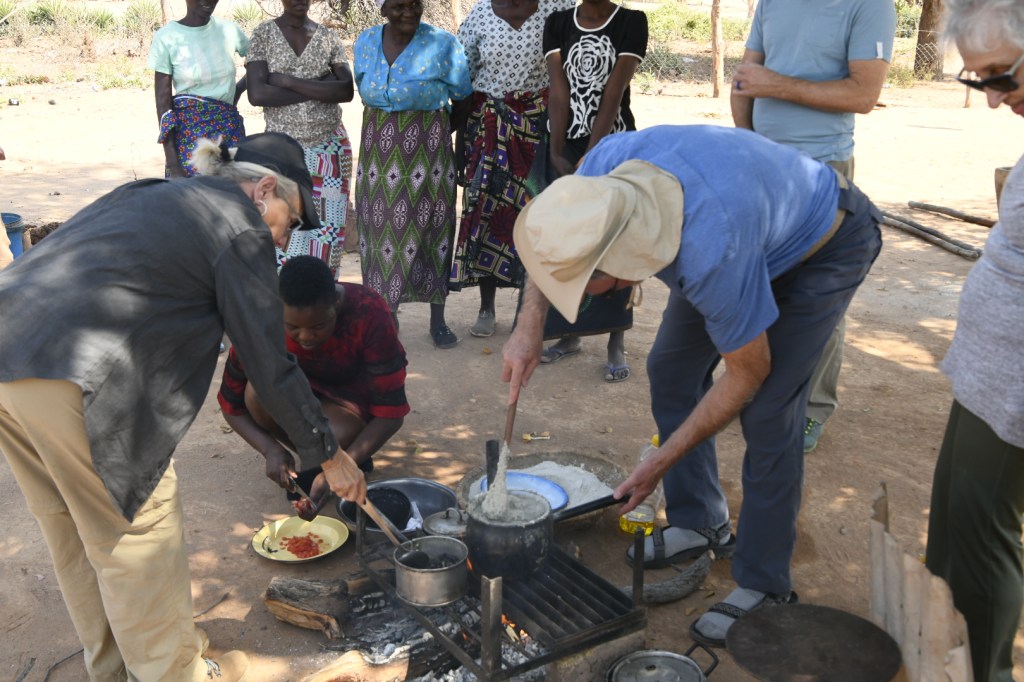
Finally, after a bit of work, we were rewarded with a feast. The village women presented us with a delicacy – a heaping plate of mopane worms. The worms are actually a species of emperor moth and they are an edible caterpillar. The “worms” are eaten by native people throughout Southern Africa and they provide protein to the local diet. The first step in their preparation is a sustain boil followed by a light sauté. Tomatoes, onions and salt are added. The taste is often described as similar to well done beef or beef jerky. They did not taste like chicken. The worms were not eaten by all the travelers but I added them to my travel menu that includes, piranha, goat, warthog, alpaca, guinea pig and other regional foods. Strangely they were very good.
Our fellow travelers helping to make the Mopane worms.
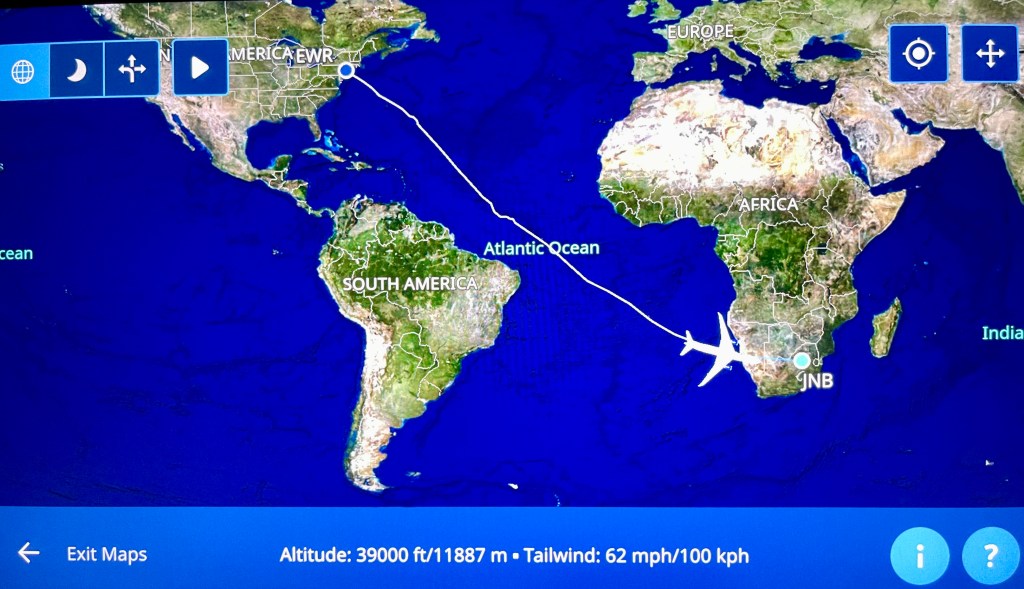
Eventually, our departure day dawned. We faced a nearly six-hour flight to Newark where we would connect with a 16 hour flight to Johannesburg. There was a four-hour layover between our flights which made our travel time a robust twenty-six hours. This had the quality of a pilgrimage and not a vacation. In New Jersey we connected with two friends from Seattle who we had met on a previous trip to Israel, Jordan and Egypt. Jack and Jean were the most serious world travelers we knew. It was hard to mention a spot on the globe they hadn’t seen in person. It was a comfort to have two friends with us and their experience always added to our confidence. As we settled into our airplane seats, the trip certainly seemed to begin on an auspicious note.
We landed in Johannesburg at OR Tambo airport on the afternoon of September 11, 2022. We were at the ragged edge of exhaustion from our flights but there would be little time to recover. We were scheduled to fly again early the next morning. This flight was to Hoedspruit where we boarded a bus to our first camp located just West of Kruger National Park. The Shiduli Lodge offered amenities that proved to be standard in our subsequent camps: tented sites sporting mosquito netting with cans of insecticides and emergency airhorns bedside. Bathrooms were indoors and included a shower…pretty posh. The tents were aligned on either side of a main structure that served as a meeting place, cafeteria and lounge area that featured a well-stocked bar. All of our camps were comfortable and relatively safe. Safety was relative because each camp had different challenges with local wildlife.
After a brief orientation that included the admonition to never walk alone – or after dark – anywhere on the site, we were served tea and led to safari vehicles for our first game drive.
We ventured out into the Karongwe Game Reserve with Charlie at the wheel and Peter in the spotter’s chair at the front of a beefy safari vehicle. We bounced through a herd of impala to the magical dance of African wildlife. The first day views of impala, elephants, baboons and other creatures were astounding for their novelty and unpredictability. We were not in Kansas anymore. Both Peter and Charlie were a tourist’s delight; they enhanced the experience with wit and obvious expertise. Their pride in Africa was infectious and motivating…we were energized and ready to enjoy the safari experience. Both men knew their jobs down to the Latin names of insects, birds and flora. We learned something about everything that scurries around. They spoke English flawlessly much to our relief. They set a great tone on ride number one…a tone that proved to carry us throughout the entire trip.
Back at the lodge, we had a chance to connect with our fellow travelers for the first time since our frantic arrival. We met a financial consultant, ex-teachers, two retired doctors, small business owners and a veteran of the publishing industry. The group was as diverse and interesting as the critters in the bush. This group looked good and promised fun and engagement.
We finally called it a day and retired to room 3. We were serenaded – without pause – by a chorus of frogs that provided the soundtrack for our entire stay. Their zesty croaking was so continuous that one wit quipped that the frog song was actually a continuous loop on a tape machine that was hidden somewhere on the grounds.
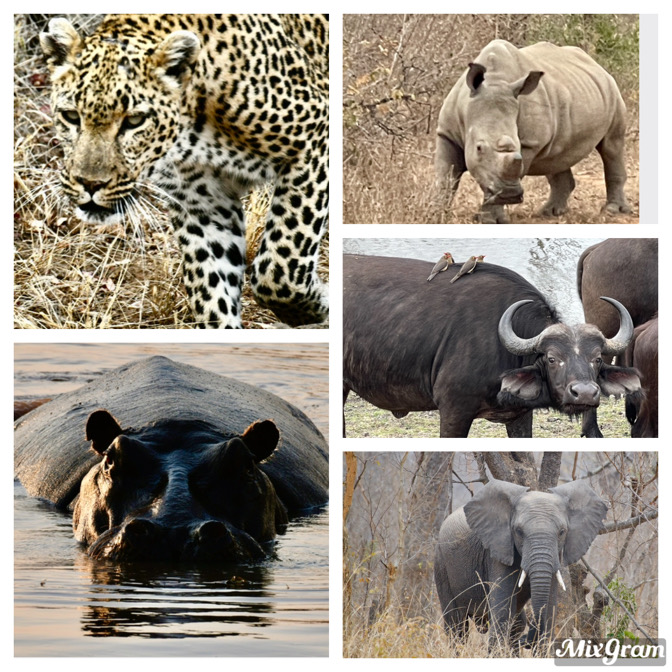
By day three at Karongwe we had seen the Big 5, including the rhinos that had been dehorned for their safety. A “game preserve” is by definition, stocked with wildlife as lodge owners are incentivized to have every guest get the Big 5 experience. For some, these sightings are the measure of a successful trip and we didn’t care that the animals we sighted might have been placed to insure our satisfaction. We were satisfied, indeed.
A memorable dinner of “potjekos” (a traditional African stew) was served under the stars. Potjekos was a combination of carrots, potatoes, cauliflower and meat steamed in a broth on an open fire and the featured meat in our stew was warthog. Unlike a common stew, potjekos is never stirred; it is allowed to rest on the coals until it is ready to eat. Warthog does not “taste like chicken” in spite of the fact that the old line was used everytime we ate something new.
We were introduced to an event that became a standard practice on our evening drives in the bush. The “sundowner” was done on the second game drive of the day as near to dusk as possible. The safari vehicle was parked in a spot that Peter and Charley had scouted for safety. The sundowner began with the unstrapping of a large cooler stuffed with beers, wine, waters and soda. Biscuits and muffins followed and we socialized for twenty minutes – or so – as the fabulous African sunset served as a backdrop. We looked forward to the sundowner, it was the perfect end to every day in the bush. Our four days at the Shiduli Lodge in Hwange had a rhythm of their own as each day featured two game drives, a daily rest in the hot hours of the afternoon, topped with a sundowner after the day’s second game drive.
On one of our drives, Linda got her first “elephant kiss.” We had pulled to the side of the road when a large bull elephant decided to have a closer look at us. The massive animal was suddenly inches from Linda’s face. Peter was quick with advice, telling Linda to freeze and not to scream. Somehow Linda was able to remain silent and immobile while she was checked out. This was the first of many close encounters.
We left Shiduli and flew back to Johannesburg to pick up a new set of travelers that would join us on the next leg of our tour in Zimbabwe, Zambia and Botswana.










 Olio Folio