A Couple Vagabonds…

African Mysteries

The next morning, we were off to the Okavango Delta and the Mogothlo Lodge. The Okavango Delta is the second largest inland delta in the world; second only to the delta of the Ganges. The delta consists of channels, lagoons, inlets and more than 150,000 islands when the water flow peaks. Originating in Angola; that flow is significant as the Congo waters join the Cutto river, merge with the waters of the Cubango river and the Okavango. These combined watercourses terminate in the sands of the Kahlahari Desert to create an otherworldly alluvial plain that is a paradise for African wildlife.

Early in the morning, we are trucked to a lagoon for a Mokoro ride. Mokoros are dug-out canoes that are polled through the shallows that are alive with lily pads and animals. There was some anxiety about being in such fragile craft in close proximity to hippos and crocs but we all survived and thoroughly enjoyed the novelty of the activity.

Here we are riding in a Mokoro…and along the bank a good looking crocodile watches.

When we hit the bank and left the canoes we immediately climbed into waiting safari vehicles for yet another game drive. A few minutes into the drive we were witness to another predation drama.

As we bumped along we spotted a puff of dust just off the rutted road. We see a honey badger apparently at play in the soft sand. Suddenly the badger is digging with a will and dirt flies in all directions. In seconds, the badger is more than two feet below ground twitching and wrestling about. When the badger emerges from his diggings he has a cape cobra in his teeth and he quickly bites off the head of the snake and begins to gnaw on the snake with gusto. Another example of the jungle law is offered.

Finally, we arrive at Mogothlo as we digest the fact that the honey badger has reminded us that we are certainly in Africa, an African proverb comes to mind: “the eye never forgets what the heart has seen” and we now know that the heart of African bush is the constant dance of life and death. To date we have completed 24 long game drives and two more are scheduled for tomorrow.

The Mogothlo camp seemed to be the only one that was fenced with an electric fence which had to be manually turned off so we could open the gate and drive through. They told us the string of electricity was 8 foot high to keep elephants from coming into the camp. They can be very unintentionally destructive just because of their size and numbers of their herds. As a matter of fact this camp staff drove us to our tents for safety..just the week before a lioness had cubs near one of the paths to our tents. Like all our camps, all the animals were up close – there were hippo highways that ran from the water in front of our tents to the back road area. We heard them all night long.

Taking a break during a game drive!
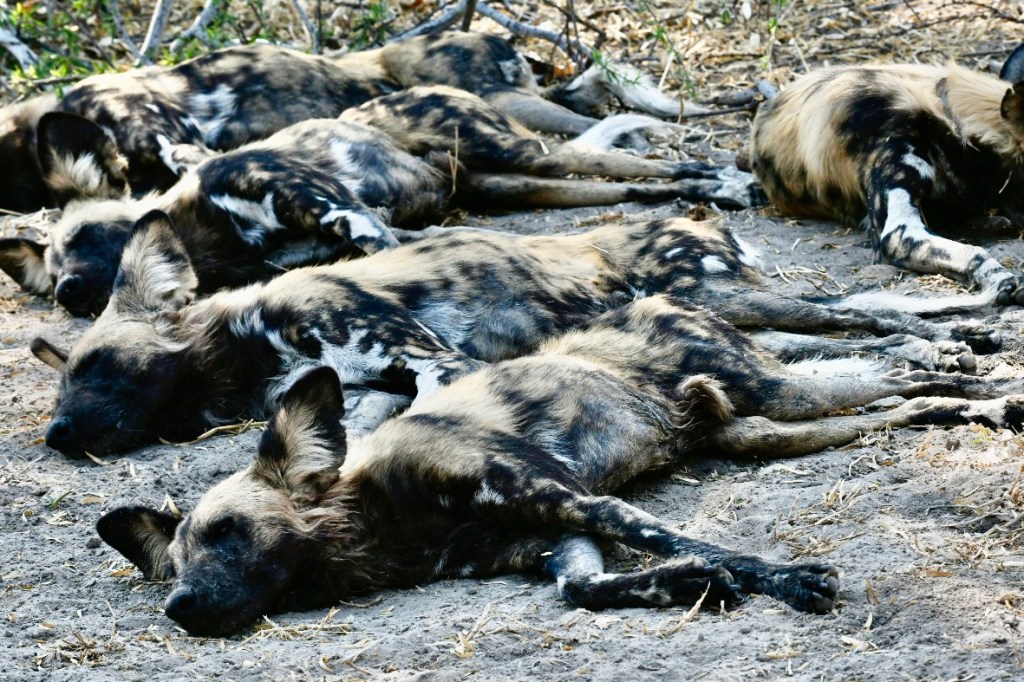
Painted Wolves exhausted after a hunting run. According to our guide they are very hard to see in the wild because they rarely rest.

26 game drives and 15 airplane flights might take the trophy for most repeated activities on the trip if it weren’t for the buffet. Three times a day we line up to select from a collection of dishes that chefs have crafted to feed a crowd. We have lost the pleasure of a leisurely menu scan followed by personal service. The buffet can become a real irritation as you stand behind a person who picks out all the green peppers from the salad and cogitates on the creative merits of the red stew or white stew. If it’s true that a person, “eats with their eyes” it is fair to say that there was a great difference between the look and the taste of most dishes.
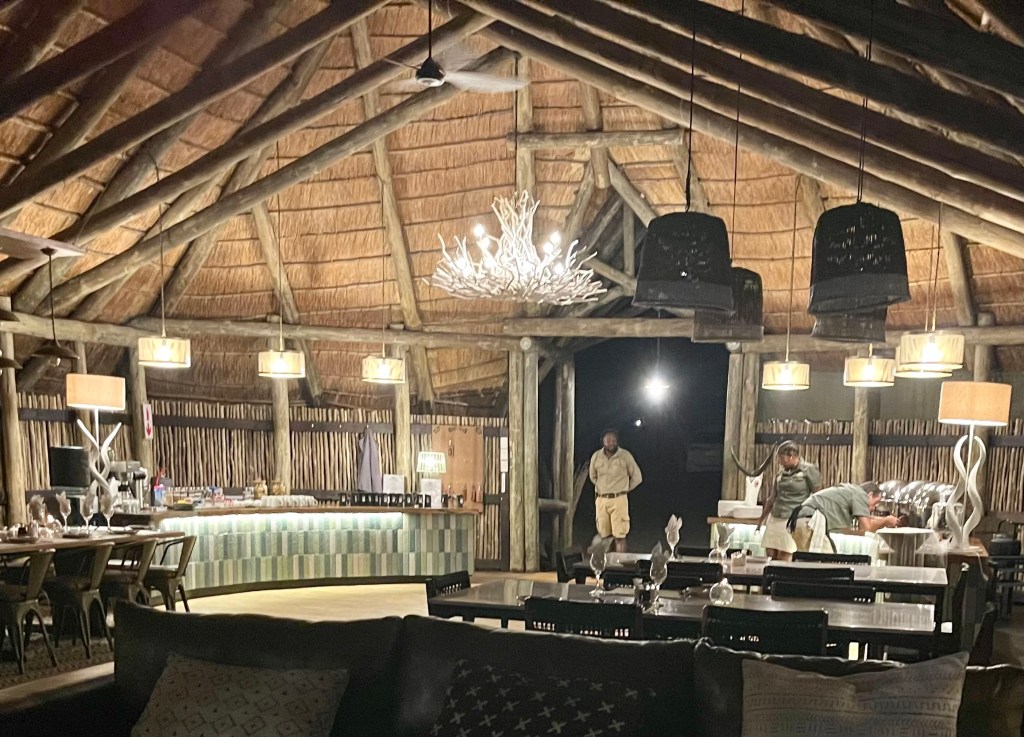
The staff setting up one of our buffets.

My personal dislike of the buffet experience limited me to a diet of oatmeal, eggs, bread and coffee and I had to remind myself that the buffet did not ruin the great experiences of Africa but I missed foods cooked to order and presented at the table. A buffet naturally preceded the big party that was thrown for us when we eventually left Mogothlo. The party was staged on the large deck at the center of the lodge. We participated in African dances and a sing-along. We were asked to present a song for our African hosts and one of our clever companions came up with the idea to sing, “The Twelve Days of Africa.” We Yankees performed with vocal atrocity to the laughter, hoots and disbelief of our African friends.

Dancers at our last night at Mogothlo.

Sunset from our tent deck.

Can you have too many sunset or sunrise photos of Africa? I think not.

A Couple Vagabonds…

African Mysteries

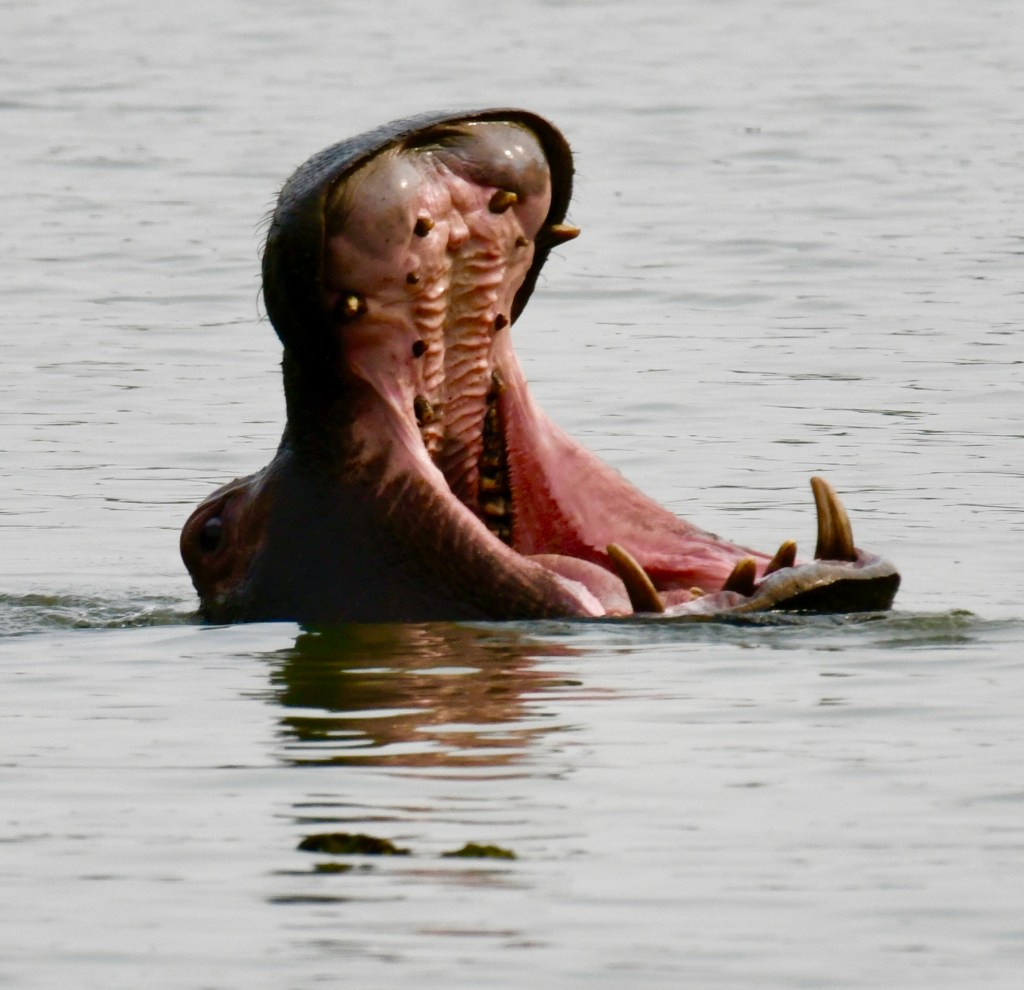
Chobe boasts one of the largest wildlife concentrations in Africa and our game drives bear that out. Giraffe families, hippos’, carmine bee eaters, fish eagles, crocodiles, ibis and herons greet us at every turn.

We will stay at Jackalberry Lodge in the middle of Botswana’s water world. Prior to arrival in Chobe we had become accustomed to a very dry landscape. In Zimbabwe – at the tail end of the dry season – we saw the arid land… the pools and watercourses in Botswana were a welcome change. Botswana also seemed more prosperous than Zimbabwe and Zambia. We learned that Botswana was indeed doing well in economic terms as its per-capita income was growing at a robust 9% rate – a rate that was competitive world wide. Mining, tourism and cattle production led Botswana’s economic boom.

Elephants crossing the Delta

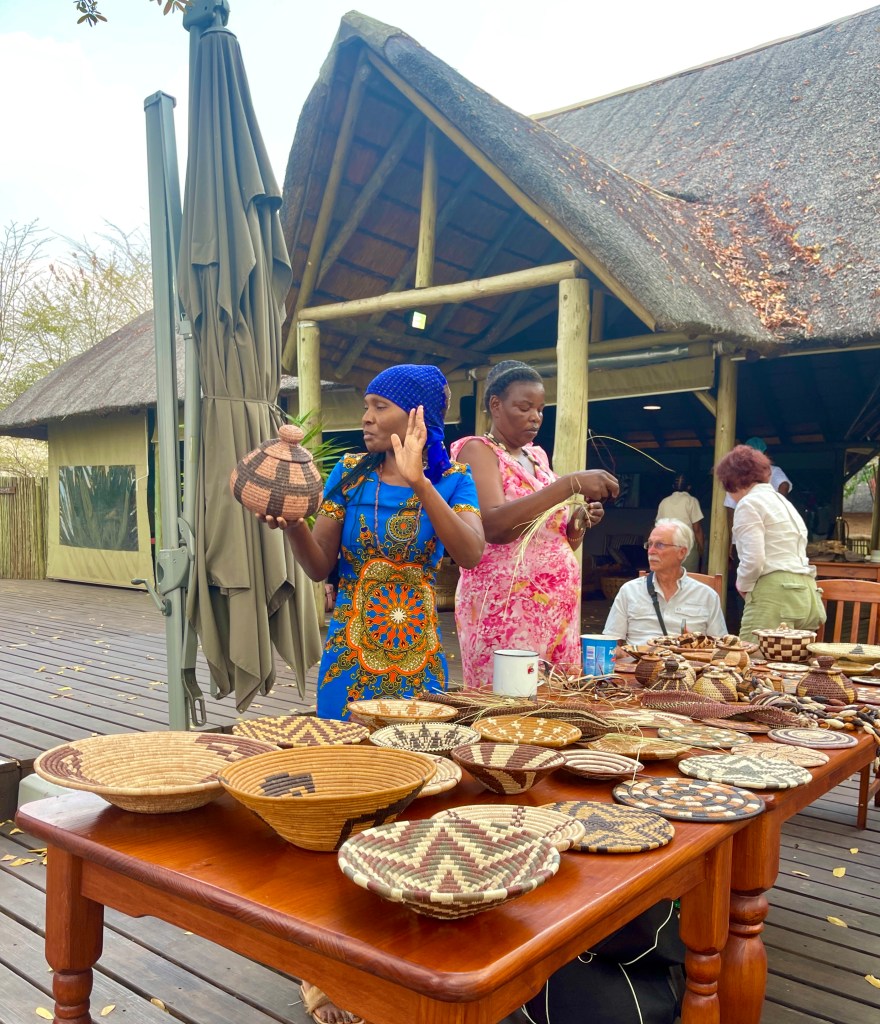
In the afternoon at Jackalberry we were visited by local crafts people who taught us the basics of basket weaving and we all took a shot at the craft…with varying degrees of success. Our instructors work was finely detailed and the baskets came in all sizes and styles. Two of their products now sit on our table at home. We note that we have reached the 14 day mark on the African odyssey.

The local basket weavers.

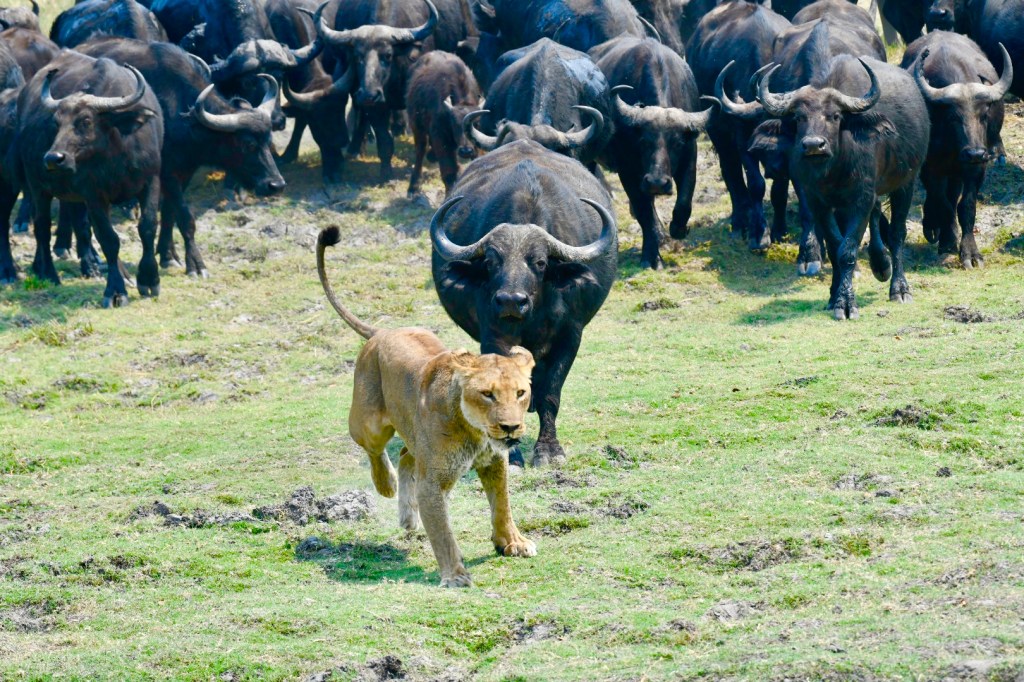
A day of game drives was in the offing and it proved to be a memorable one. We drove up on a scene we had only seen on film. Ten lions were on the hunt. We heard the distinctive warning bark of an impala announcing danger and marked the lions on a stealthy approach to a herd of cape buffalo. The lionesses worked in a crouch through the high grass in a vee formation that cut off retreat on the buffalo herd’s flanks. They slowly closed the arms of the vee to establish a point of attack. All of the predator’s movements were painstakingly slow; their approach took a little more than an hour. We had no sense of time passing as we watched and cameras clicked.

Linda taking as many photos as possible!

The herd responded with multiple position changes to create a defense. A wall of large bodies and deadly horns was a difficult obstacle to the hungry lions but, in time, the lions were able to establish an attack point. A bull buffalo would challenge the lions at their attack point and the lions would repeatedly retreat, regroup and try new launching areas.

Things eventually came to a crisis and the lions charged forward. Two lions actually got on the back of a buffalo, then one slipped under it, then both were driven off by a wall of aggressive defenders. It was a near kill. Group defense drove the lions away until a herd of elephant interposed themselves between predator and prey. We watched this for several hours and realized that we had witnessed “the law of the jungle” in real time and with proximity. We were reminded that something had to die for something else to live.

It was amazing.

Chobe was a definite eye opener.

Our final night at Chobe had arrived and we were regaled by dances and songs performed by the locals. The dances were explosive and complex giving us another taste of tribal culture; and a smooth transition to the travel that would come in the early morning.

A Couple Vagabonds…

African Mysteries

The day after our village visit was the first time we experienced the African bush place. We flew to Livingstone in Zambia where we were to take a bus from the dirt airstrip to Kafue National Park. Kafue was created by an initiative to link multiple park areas to form a large, “conservation area” around the Kafue River region. Rivers and swamp areas ring Kafue creating habitat for more than 50 animal species and a home for more than 500 bird communities. We were promised a rich animal experience.

The Kafue River, Zambia

We will stay at the Lufupa Tented Camp on the banks of the Kafue River. Linda and I are booked into tent number one and as we move to the tent we realize that we are again at the farthest distance from the lodge site. That night we hear a continuous scrabbling below the tent and are informed that the sound comes from Lulu the warthog and her five offspring who are nested below us. Lulu and family call Lufupa home and for the next few days we will do the same. Lulu doesn’t seem to mind the intrusion.

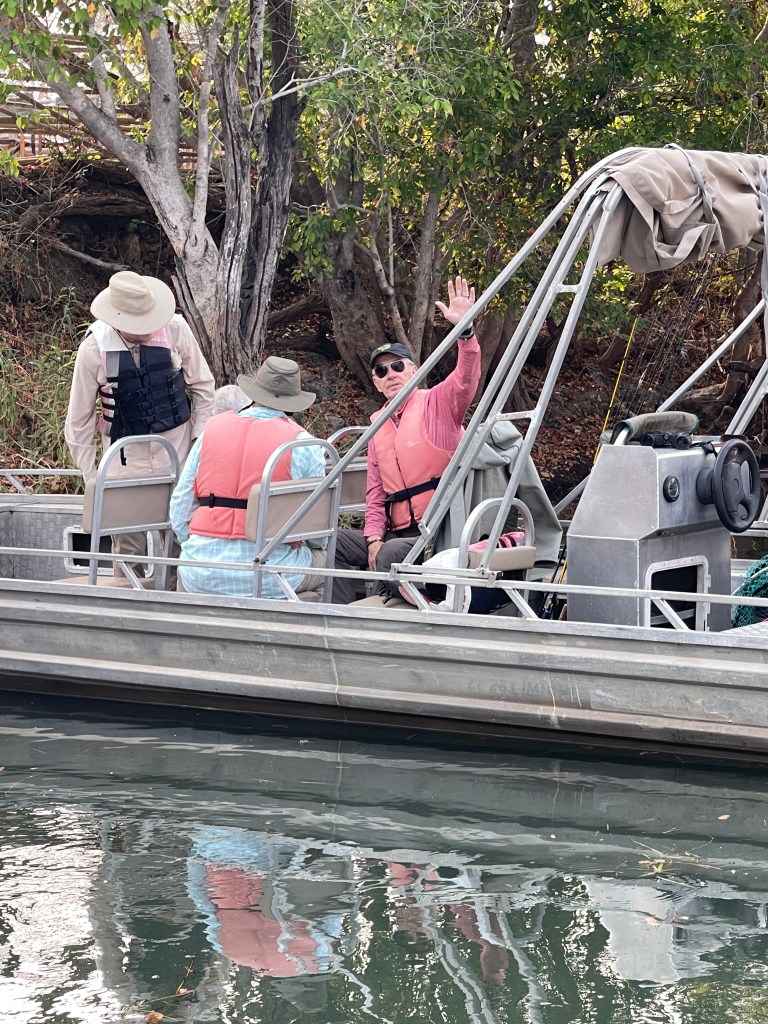
The men in the group spend the afternoon fishing for bream and tilapia while the women float the river on a game viewing cruise. It proved to be nerve wracking to be on a small boat with five large men casting from every point on the compass. Hooks were flying from every direction but we miraculously avoided any punctures. The trip was successful as enough fish were landed to make a serious contribution to the evening’s dinner menu. The ladies were rewarded with close ups of the hippos and crocs.

The men went fishing, while the women

went to see animals along and in the river.

After dinner, the night game drive offered two quick lessons about local matters. The first lesson was about the omnipresent tsetse fly. This aggressive insect had an outsized role in African history because of its transmission of disease and its painful bite. The second lesson was in relation to the tsetse fly and it concerned the many uses of elephant dung. The smell of DEET and other insecticides hung in the air but the greatest relief from the pests came from an old paint can full of burning elephant dung that hung from the rear bumper of the safari vehicle. The tsetse is a member of the family that includes the common housefly, a fact that made its blood sucking bite no less painful. Their relentless attacks led directly to a short course on the uses and benefits of elephant dung.

Our guide shared the knowledge as he picked up balls of semi-dry dung and stuffed them into the paint can fire. The resulting smoke drove the flies away long enough for him to share dung factoids. The same smoke that stopped the insects was also used for pain relief. Dung is also a renewable energy source and a food source for birds and baboons that eat undigested seeds in the scat. Elephants produce enough dung in a day to produce 115 sheets of very fine paper. In addition to being a high-quality fertilizer, the dung is also used in the production of artisanal beers and coffees. Perhaps the most disgusting use was the fact that bush people facing dehydration can squeeze water from the dung to avoid a grisly death. Like almost everything in Africa, elephant dung was a good deal more than what met the eye.

Our last day in Kafue was bittersweet as we looked forward to our next camp and regretted leaving a magical place. In the morning, we will leave Lufupa Camp for a bush plane flight to Chobe National Park in Botswana. We bounced into Botswana on the thermals and crosswinds of the desert and as we bump into a landing on a dirt strip, we taxi past a dilapidated shed that contains old rags and a single first extinguisher. As we pull even with the structure the pilot announces, “Terminal One.” We were happy to be on the ground.