
African Mysteries

Capetown is known as “the mother city” of southern Africa, a city that sits at the base of Table Mountain in southwestern Africa. In historic terms, the first mention of the area by a European was by Bartholomew Diaz in 1488 during an attempt to round the cape. Vasco de Gamma actually mentions the cape in his ships’ log in 1487, slightly stealing Bartholomew’s thunder. After the cape contacts achieved by the Portuguese navigators, the sailors of the Dutch East India Company established a supply station and they visited regularly between 1652 and 1797. Their influence on the city remains in the architecture, signage and language of Capetown. Before long, the British arrived and defeated the Dutch at the battle of Blaauwberg in 1806. The British influence remains strong. Colonial events established Capetown as the “first city” – the mother city – of Southern Africa.
Our first activity in Capetown is a home-hosted dinner where we would meet locals and hear their stories. We were less than fresh and our conversation quickly devolved into a long discussion of cuisine, cooking techniques and the building of the dishes that were served. The two ladies who hosted us were lively and charming and we enjoyed the talk of domestic issues rather than current events or future visions. The talk was relaxing and just light enough after our flight.
We returned to The Sunsquare City Bowl Hotel and the following morning a buffet breakfast waited us – as usual. We happily anticipated the walkabout in the city that would start after breakfast. Our new guide was Khotsu an energetic man who immediately informed us that his name meant “peace.” He headed us into the city, through multi-colored Dutch neighborhoods and informed us of the fact that our day would consist of a visit to the top of Table Mountain followed by a leisurely stroll through the gardens of Kirstenbosch.
We took the famous funicular ride to the summit of the mountain and were in agreement that the mountain’s status as a “new 7th wonder of nature” site was well deserved. At 3,564 feet of elevation we found rich biodiversity and breathtaking views of the surrounding country. Over 8,000 plant species have been identified on the mountain (to date) and the place is home to hyrax, peregrine falcons, baboons and many other animals. The mountain top was a feast for the eyes.

The native name for the mountain is hoerikwagoo which translates to, “the mountain of the sea”, a name which is apt because one can view the entire coastline that leads to the Cape of Good Hope and the Atlantic port of Cape Town, in a single view. Table Mountain was one of the rare places you don’t want to leave but we were boarding a van for a ride to the gardens at Kirstenbosch.
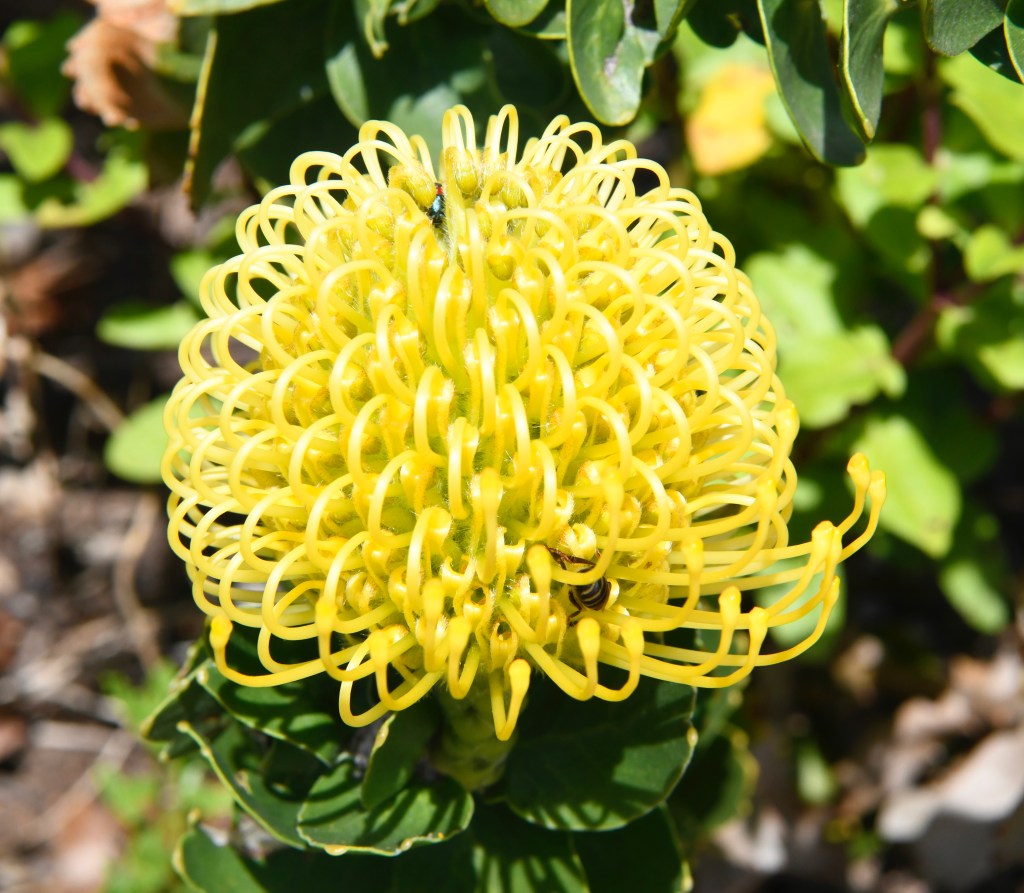
The quiet, contemplative walk in the lush gardens among 41,000 species of indigenous flowers and other flora gave us the opportunity to decompress as we strolled among the monumental statuary and a stand of King Proteus, the national flower of South Africa. After a visit to the nesting owls in the garden, Khotsu suggested that we travel to the Capetown waterfront for lunch.
The Capetown Waterfront is a gem in the ring of the city where shopping malls, arcades, restaurants, a performance space and a clutch of shops are set along the harbor front. Some of the best seafood in the world is served in the harbor and we experienced that quality. After lunch, Khotsu suggested that we walk a few miles back to our hotel, a march that furthers our boots on the ground contact with the city. Back at the hotel, free time is declared and we are pleased with the opportunity to refresh, re-pack and regroup. Leisure time is at a premium.
 Olio Folio